Solutions • Gold verification • Gold buyers, bullion dealers and refiners

Gold verification kit: eddy current tester, specific gravity and ultrasonic testing for bars, coins and jewelry.

At the counter every instrument has its own job. The XRF analyzer gives you fineness and alloy in seconds, the specific gravity balance checks the whole piece, the eddy current tester verifies coins and bars one after another, and ultrasound travels through the bar from one face to the other. We offer every instrument in the kit, from the eddy current tester to the specific gravity balance, and help you choose the right combination for what you buy every day.

Reply within 24 hours · Kit built around your counter · Technical support in Italy

In brief

What is a gold verification kit?

It is the set of instruments a gold buyer, bullion counter or refiner uses to check the gold it buys without damaging it. It usually includes an XRF analyzer for fineness and alloy, a precision balance with a specific gravity kit, an electronic eddy current tester for coins and bars and, for anyone buying bars, an ultrasonic probe. Each instrument measures a different property of the piece, and together they cover jewelry, coins and bars.

We help you choose your gold verification kit: reply within 24 hours

How much does a gold verification kit cost?

A balance with a specific gravity kit, a coin and bar tester and an XRF analyzer sit at very different price points, and not every counter needs all of them. Tell us what you buy and in what volume, and the quote includes only the instruments you need, with reference samples for your formats.

  • Reply within 24 hours
  • Kit built around your counter
  • Technical support in Italy
Gold verification

How a gold verification kit works.

Each instrument measures a different physical property of the same piece. XRF reads the composition, the balance derives density from weight in air and the buoyancy of water, the eddy current tester measures how well the metal conducts electricity, and ultrasound times the sound crossing the bar. When the four numbers tell the same story, the price you offer the customer rests on data instead of a hunch.

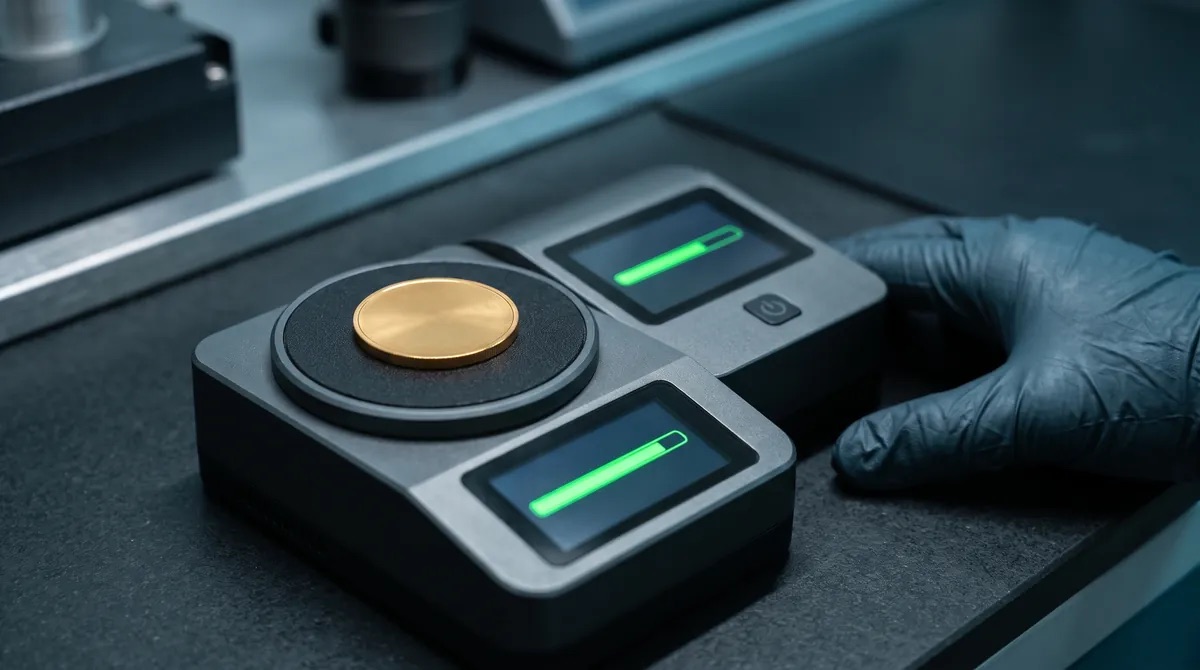
Gold bullion coin resting on the flat sensor of an electronic eddy current tester on a gold buyer's counter
Electronic eddy current tester

Coins and bars verified in seconds

The sensor generates an alternating magnetic field that induces small currents in the metal, and the instrument measures how easily the piece lets them flow. Fine gold conducts far better than tungsten and the alloys used in fakes, so a bar or coin with a different core reads outside the window of the genuine product. At low frequencies the currents reach a few millimeters below the surface, at high frequencies they stay in the outer layers, which is why bar testers often work on several frequencies.

  • Comparison against the electrical signature of the reference coin or bar, format by format.
  • The field passes through plastic, so many models can measure a coin inside its capsule.
  • Best suited to high fineness, such as 999 bars and 916 coins, where the conductivity of gold is easiest to recognize.
One job per instrument

XRF, specific gravity, eddy current and ultrasound: what each one is for

Side by side, the four instruments cover every piece that crosses a precious metals counter. The table sums up the job of each one, the pieces it handles best and the time a measurement takes.

What XRF analyzers, specific gravity, eddy current testers and ultrasound are used for in gold verification
InstrumentWhat it is forSuitable piecesTypical time
XRF analyzerFineness in parts per thousand and alloy composition, with a spectrum to save in the recordJewelry, coins, small bars, dental gold, silver, platinum and palladiumA few seconds per reading, usually three spots per item
Specific gravity (hydrostatic balance or density meter)Density of the whole piece, compared with the value expected for the fineness and alloyCompact shapes without stones or hollows, such as small bars, coins, solid rings and ingotsA few minutes for weighing in air, weighing in water and the calculation
Eddy current tester (conductivity)Electrical conductivity of the metal, compared with that of the genuine productBullion coins and high-fineness barsA few seconds per piece, even across a batch
UltrasoundSpeed of sound from one face of the bar to the other, which changes if another metal sits insideBars and small bars with two accessible parallel facesA few seconds per spot, with a thin film of couplant gel

Specific gravity and eddy current testing work well together because they look at two independent properties. Tungsten has a density of 19.30 g/cm³ against 19.32 for gold, according to the NIST material tables, so a balance alone cannot tell them apart. Tungsten conducts electricity very differently, though, and sound travels through it at a different speed: for longitudinal waves, Technische Universität Ilmenau, in a paper presented at the 2014 conference of the German society for non-destructive testing, reports 3,240 m/s in gold and 5,261 m/s in tungsten.

The specific gravity calculation, the table of values by fineness and the errors that shift the result are covered in the article on specific gravity of gold and gold-plated items. For the fineness of jewelry at the counter, see the page on the XRF analyzer for gold buyers.

Recommended kits

Which kit for which business.

Buyers of used jewelry

The daily work is chains, rings, bracelets and earrings at different finenesses. Here the core of the kit is the XRF analyzer for fineness and alloy, alongside a balance with a specific gravity kit for solid, compact pieces. If coins or small bars come in now and then, an eddy current tester completes the counter.

Bullion counters buying bars and coins

Anyone buying investment gold from private sellers sees small bars from 5 to 1,000 grams and coins of known formats. The typical kit combines an eddy current tester with references for the formats you handle, ultrasound for bars, a precision balance for weight and density, and XRF for fineness and alloy.

Precious metals refiners and smelters

At material intake you need speed and traceability. A benchtop XRF sorts lots of jewelry scrap, density and ultrasound check third-party bars, and fire assay by cupellation under ISO 11426 settles the fineness of lots to be melted or disputed.

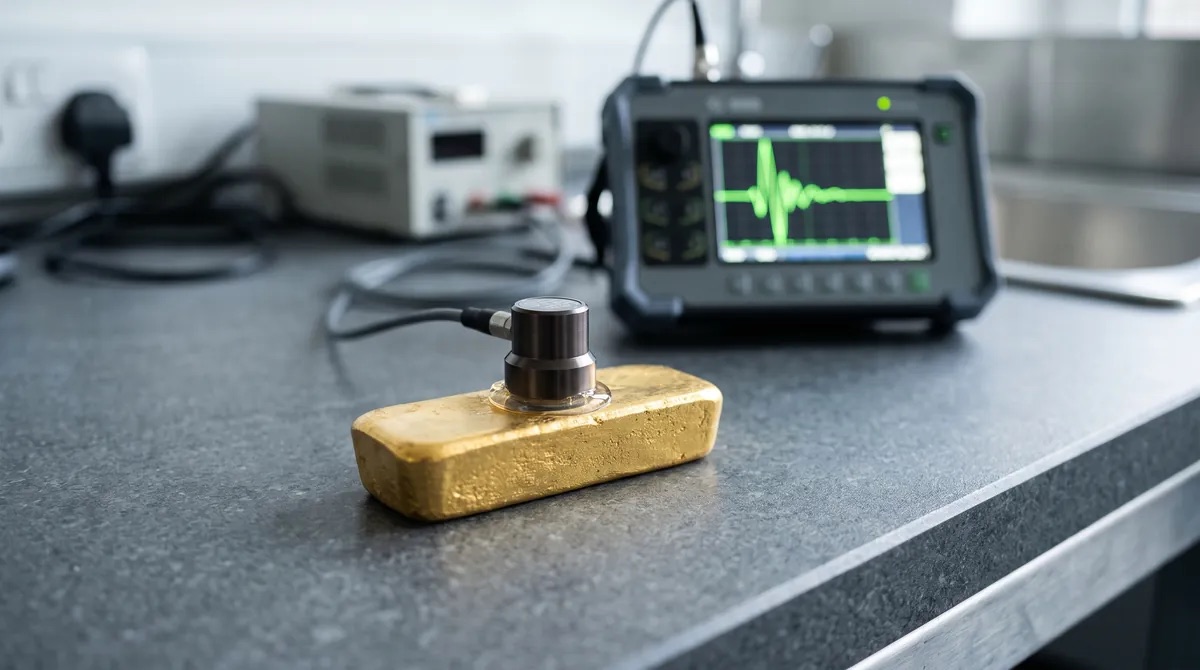
Small gold bar on a laboratory bench with an ultrasonic contact probe on its top face and the instrument in the background
Ultrasound for bars

Sound travels through the bar from one face to the other

The probe sends a pulse into the bar and waits for the echo from the opposite face. Knowing the thickness, the instrument works out the speed of sound, which has a precise value in gold. A tungsten insert, much faster, brings the echo back early and shows up without cutting or drilling the piece. The London Bullion Market Association reports that inserts of this kind were found in a few small bars and that most London vaults installed ultrasonic testing equipment in the early 2000s.

  • You need access to two parallel faces and a thin film of gel between probe and metal.
  • Several measuring spots cover the whole surface of the bar, corners included.
  • There are compact versions for small bars and laboratory systems for large formats.

Which kit does your counter need?

Tell us what you buy, the coin and bar formats you see most often and how many purchases you make in a week. That shows which instruments you really need, and the quote includes only those.

  • Jewelry, coins and bars
  • Technical support in Italy
Counter cases

Four pieces at the counter and the instrument that closes the deal.

Bracelet stamped 750

XRF reads fineness and alloy at three spots, one of them on the clasp. If the bracelet is solid, specific gravity confirms the reading with an independent measurement: a yellow 750 alloy sits around 15.5 g/cm³, gold-plated silver stays below 10.5.

Bullion coin

For the most common formats, diameter, thickness and weight are published by the mints. The eddy current tester compares the coin with the reference for that format and the balance checks the weight to a hundredth of a gram.

100-gram bar

Weight, dimensions and density must match those of a fine gold bar. Then the eddy current tester and ultrasound check that no other metal sits inside, and XRF confirms fineness and alloy in seconds.

Lot of jewelry scrap

XRF splits the lot by fineness before melting, so 18 karat gold doesn't get mixed with 9 karat. The fineness used to pay for the melted bar is then set by the refinery's assay.

Technical criteria

How to choose verification instruments.

Before looking at models, pin down a few points, because the choice depends on what walks through your door more than on the catalog.

What you buy most often

A counter that handles almost only used jewelry needs different instruments from one that buys bars from private sellers. Start from the most frequent piece and the most valuable one, because those are the pieces that pay for the kit.

Coin and bar formats

Eddy current testers compare the piece with a reference, so you need settings for every format you handle. Ask which formats are already included and how new ones are added.

Balance resolution

On an 8-gram ring, a 0.001 g balance gives specific gravity with an error of a few hundredths, while a 0.01 g balance is off by about three tenths. For pieces of a few grams you need milligram resolution.

Bar thickness and geometry

Ultrasound needs two parallel faces and a measurable thickness, while density needs the whole piece immersed. Check that the largest bars you buy fit the balance and the sample holder.

Reference samples and routine checks

Every instrument is checked against known samples before the day starts and after a knock or a move. A certified reference bar and coin cost little compared with one fake paid in full.

Recording measurements

Italian Legislative Decree 92/2017 requires gold buyers to keep a record for every purchase with a description, valuation and photos. Instruments that save or print the result make the valuation defensible if someone disputes it.

The full procedure for checking fineness at the counter is in the gold verification guide for gold buyers, the measurement method in the article on XRF analysis of gold and precious metals, and the other instrument categories in DIPITECH solutions.

Counter instruments or laboratory

Instruments at the counter or a laboratory assay?

The instruments in the kit are there to decide within minutes, in front of the customer, whether to buy a piece and at what price. They work without marking the metal, and the measurement can be repeated as often as you like, which is why they stay on the counter.

When the lot is valuable or the fineness has to be certified, for example before melting or in a dispute, the reference remains fire assay by cupellation in a laboratory. The kit tells you which lots to send for assay and which to pay for straight away, and saves you analyses on pieces that don't need them.

The DIPITECH approach

The kit is built around what you buy.

We need to know what crosses your counter: a jewelry buyer and a bullion counter buying one-kilo bars need different instruments, and you often need less than you think.

What to send us for an assessment

  • The items you buy most often: jewelry, coins, small bars, dental gold.
  • The coin and bar formats you see most.
  • How many purchases you make per day or week.
  • How you check today: touchstone and acids, balance, XRF or laboratory.
  • The instruments you already own, so you don't buy them twice.
  • Whether you work from one or more shops.
FAQ

Frequently asked questions about gold verification

How do you spot a fake gold bar with a tungsten core?

Tungsten has almost the same density as gold, 19.30 versus 19.32 g/cm³, so the weight and dimensions of the bar can match. What gives it away is electrical conductivity, which an eddy current tester compares with that of the genuine bar, and the speed of sound, which in tungsten is about 1.6 times that in gold and brings the ultrasonic echo back early. For a bar bought from a private seller, it pays to run both checks before paying.

How does an electronic eddy current gold tester work?

The sensor creates an alternating magnetic field that induces currents in the metal, and the instrument measures how easily the piece lets them flow, that is, its conductivity. The value is compared with the window of the reference product, for example a given coin or a fine gold bar. At low frequencies the currents reach a few millimeters below the surface, at high frequencies they stay in the outer layers.

Is a hydrostatic balance enough to determine gold fineness?

Not on its own, because density also depends on the alloying metals: an 18 karat white gold with palladium is denser than an 18 karat yellow gold, and one with nickel is lighter. Hydrostatic weighing is very effective, however, at exposing a compact piece that is plated or made of a light alloy, which comes out well below the expected value. On jewelry with stones, hollow parts or solder joints the result becomes less reliable.

Which instruments does a gold buyer need to verify gold?

For used jewelry the reference is the XRF analyzer, which gives fineness and alloy in seconds without marking the piece, alongside a precision balance with a specific gravity kit. If you also buy coins and small bars, add an eddy current tester, and for valuable bars an ultrasonic probe. We help you choose based on what you actually buy.

How much does a gold verification kit cost?

It depends on which instruments you need and how many coin and bar formats you handle. A balance with a specific gravity kit, a coin tester and an XRF analyzer sit at very different price points, and not every counter needs all of them. Tell us what you buy and we'll send you a quote with only the instruments you need.

How do I request a quote?

Message us on WhatsApp, by email or through the form, and tell us the items you buy most often, the coin and bar formats, how many purchases you make and the instruments you already own. We reply within 24 hours with the right configuration and a quote.

Application support

Support with your choice, before and after you buy.

We help you choose verification instruments for the pieces you actually buy. After purchase, technical support stays in Italy.

Contact

Let’s find the right instruments for your counter.

From buyers of used jewelry to bullion counters buying bars, the kit always starts from what you describe.

Application request

Tell us what you buy.

List your most frequent items, the coin and bar formats and how many purchases you make; mention any instruments you already own.

WhatsApp