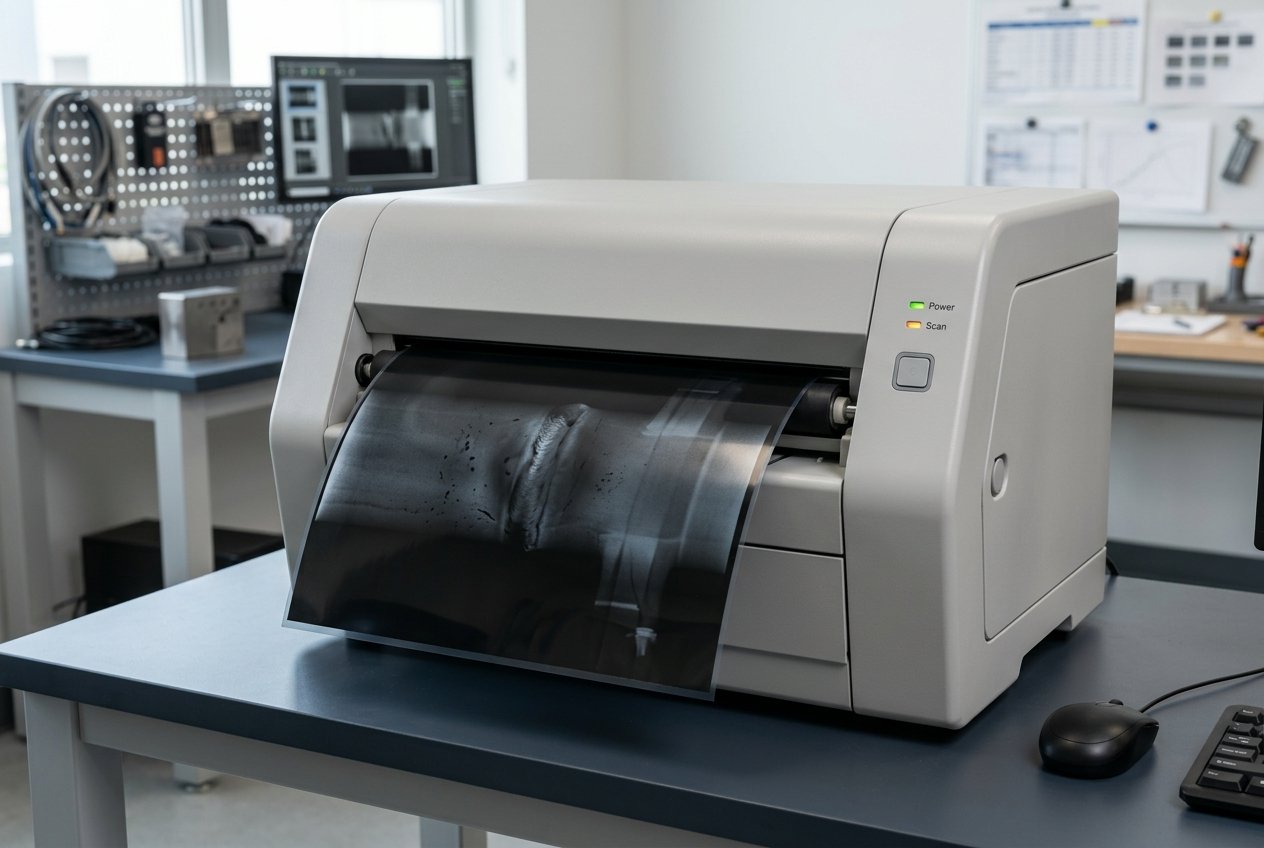
In many manufacturing companies, the technical memory of twenty years of inspections still sits in envelopes of radiographic film. Those films prove that a welded joint was accepted and serve as the reference when a component comes back to the shop. They are also the record a certification body or a customer can ask for years later. And film is a medium that ages. The emulsion deteriorates, markers fade, and finding a single film takes time and a viewer in working order.
Turning those films into digital images only makes sense if the file can still be read against the same criteria as the original radiograph. A scan that flattens the dark areas keeps the paperwork and loses the evidence. That is why film digitization follows precise technical rules, set by the ISO 14096 series, and comes down to five quantities: resolution, bit depth, readable optical density, noise and file format.
What a film archive is worth, and what losing it costs
The reasons to recover a film archive add up, and one alone rarely justifies the spend. The first is preservation. A well-stored film lasts a long time, but a fire or a flood wipes out in an hour whatever was never copied, while a file can be replicated in several copies and places. When the original becomes unreadable and no copy exists, the only option is to shoot the radiograph again, if the part is still accessible, with a new exposure, machine time and source handling.
Then there is time: finding a ten-year-old film can take hours in the archive. The same image, once indexed, opens in seconds and can be sent to a customer, a third-party inspector or another plant without shipping the original. Space matters too, as linear meters of climate-controlled cabinets shrink to a folder on a server. And if new inspections already run on CR or DR, film forces you to keep two archives with different search logic, which digitizing the backlog brings together.
Above all of this there is often a formal obligation. In aerospace, oil and gas, power generation and pressure equipment, inspection records must be kept for years, in several cases for the whole service life of the component or plant. A digital archive in a standard format, with verified copies, meets that obligation without depending on a physical medium that keeps degrading.
Recovering the archive and going digital are two different projects
The distinction causes a lot of confusion in requests for quotation. A film digitizer turns an already exposed and processed film into a digital image: it works on the existing medium and leaves the way inspections are performed unchanged. Going digital means changing acquisition upstream, with digital radiography systems that no longer use film.
The two routes often coexist. The digitizer protects what has already been produced on film, while photostimulable phosphor plates (CR) and flat-panel detectors (DR) concern new inspections, throughput and dose. Their qualification tests are separate as well. For CR there is ASTM E2446-24, run by the manufacturer, and ASTM E2445/E2445M-20, run by the user, and neither has anything to do with film digitization. If you are weighing both directions, the comparison is in our article on CR versus DR in industrial radiography, and detector criteria are in the piece on DR detectors for weld inspection. This article stays on the first topic: the film already exists, and it has to become an image without losing information.
How a scanner measures transmitted light point by point
The principle is to measure, at each point of the film, how much light gets through. The quantity that describes film blackening is optical density, the base-ten logarithm of the ratio between incident and transmitted light. A density of 2.0 lets through one hundredth of the light, a density of 4.0 one ten-thousandth. Blackening in turn comes from X-ray attenuation in the part, tabulated in the NIST mass attenuation coefficients, and once converted into a value per pixel it rebuilds the grayscale image.
For the measurement to mean anything, the density scale has to be tied to calibrated instruments. ASTM E1079-21 covers the calibration of the transmission densitometers used to check films; without that reference, a digitizer that "reaches Dmax 4.2" is a catalog promise. Scanning technologies then differ in how they light the film and how they collect the light that passes through it.
Laser scanning digitizers
In laser systems a focused beam sweeps the film line by line, in a flying-spot scheme, and a photomultiplier collects the diffuse light behind the film. Point illumination almost entirely prevents light from bright areas from contaminating the measurement in dark ones, as Uwe Zscherpel of BAM in Berlin explained in a 2000 paper on NDT.net. That is why laser scanners have long been the reference when high-density films must be re-read for interpretation.
CCD or CMOS line digitizers
In sensor-based systems the film is lit diffusely and a line of CCD or CMOS elements collects the transmitted light. They are generally faster and cheaper, and in recent years their dynamic range has improved a lot. The historical weak point remains reading the highest densities, where scattered light and noise blur the detail. In the same BAM comparison, office and medical scanners could not reach the contrast sensitivity needed above density 4. For archives with moderate densities a good sensor may be enough; for dense films, check the Dmax that is actually readable, which often differs from the datasheet figure.
The four parameters that decide quality
A film digitizer is judged on the balance between four quantities. Looking at only one leads to the same mistakes people make when they choose a digital detector on pixel pitch alone.
Spatial resolution (µm or dpi)
This is the pixel size at the film plane. A 50 µm pixel corresponds to about 508 dpi, a 100 µm pixel to about 254 dpi. By the sampling theorem the pitch should be about half the smallest structure you need to resolve. Below that, fine defects disappear; far above it, files swell without adding information, because the limit is still the grain and sharpness of the original film. The CEN draft standard described by BAM in 2000 accordingly tied pixel size to energy: from 15 µm for radiographs below 100 keV in the strictest class up to 200 to 250 µm for cobalt-60.
Bit depth (bits per pixel)
This is the number of gray levels the system can tell apart: 256 at 8 bits, 4,096 at 12 bits, 65,536 at 16 bits. A radiograph contains very fine density transitions, and there must be enough levels to avoid banding and to adjust window and contrast during reading without artifacts. The same CEN draft asked for at least 12 bits in the strictest class and 10 in the others, for a digital value proportional to density. It added two more bits when the value is proportional to light intensity.
Maximum readable optical density (Dmax)
Optical density grows on a logarithmic scale, and each extra unit means ten times less transmitted light. Industrial films work up to density 4 and sometimes 5, the BAM paper noted. If the scanner cannot read up to that value, the darkest areas, which may hold exactly the critical indications, come out black. The reference film in ISO 14096-1:2026 covers densities from 0.5 to 4.5, and Dmax remains the most underrated parameter in quotations: it separates a system built for interpretation from one fit only for browsing.
Signal-to-noise ratio (SNR)
Even with adequate resolution and Dmax, a noisy digitizer confuses a small density difference, that is a defect, with its own noise. SNR governs density contrast sensitivity, which ISO 14096-1:2026 checks on the reference film down to 0.02 optical density. Film system classifications, ISO 11699-1:2008 and ASTM E1815-18(2023), describe performance in terms of gradient and granularity, meaning contrast and noise, and the scanner must not add noise of its own to that of the film.
The four parameters are read together. Fine resolution is useless if noise drowns the contrast of small structures; a high Dmax is not enough if there are too few bits to render the gradations in dense areas. Real quality comes from their balance, and that balance is exactly what qualification tests.
Do you have a film archive to recover?
Tell us the film formats, typical densities, number of films and the purpose of digitization: we will tell you which class you need and which system meets it, with a tailored quote within 24 hours.
Email us Message us on WhatsAppPreparing films before they go into the scanner
Quality also depends on what happens before scanning. The first step is to know the film stock: film class, actual densities, storage condition. The class helps estimate the expected grain and contrast, and therefore the resolution and SNR the scanner will need.
Physical condition matters next. Dust, fingerprints, static charge and curled films introduce artifacts that no scan setting can recover, and cleaning with suitable products, controlled humidity and correct handling reduce them at the source. If the original processing was unstable, the film itself may be degraded. Processing control has its own guide, ASTM E999-20(2025), and it is worth knowing whether it was applied at the time.
Before buying, measure the real Dmax of the densest films in the archive with a calibrated densitometer. That measured value sets the minimum Dmax the scanner must read with margin. Dedicated references exist to verify performance: the ASTM E1936-20 reference radiograph, developed by EPRI and, according to BAM, also taken up by ASME standards and the European project, and the reference film of ISO 14096-1.
What ISO 14096 requires, and which class to choose
Film digitization has a standard of its own. The ISO 14096 series, Qualification of radiographic film digitisation systems, came out in a new edition on September 7, 2026, replacing the 2005 one. Part 1 defines the parameters to measure, namely spatial resolution and linearity, density range, density contrast sensitivity and the characteristic transfer curve, together with the reference film. Part 2 sets minimum requirements and three quality classes, which the user picks job by job according to radiation energy, penetrated thickness and the quality of the original film.
This is where the most common misconception hides. People tend to assume that archiving demands less than interpretation, but the logic of the standard runs the other way. In the CEN draft described by BAM, from which the standard derives, the strictest class, DS, was meant for digital archiving that replaces the film, with negligible loss of noise performance and resolution. Classes DB and DA served on-screen analysis, with the films still to be kept. If you plan to discard the films after scanning, you are in the most demanding class, and the updated numerical requirements are in ISO 14096-2:2026.
To stand up in an audit, qualification has to be documented and repeated: an initial check with the reference film, periodic checks, recorded results. Photomultipliers, sensors and light sources drift with use, and a system qualified only once offers a guarantee that empties over time.
Metadata, formats and DICONDE: an archive that outlives the software
A file without context is half the job. A digitized radiograph is worth something when it carries what makes it traceable years later: component, material, thickness, procedure, source, operator, result, date.
The reference format in nondestructive testing is DICONDE, defined in ASTM E2339-21 as the NDT adaptation of the medical DICOM standard, managed by NEMA, which has underpinned the exchange of diagnostic images for decades. DICONDE keeps image and metadata in a single container, so the archive stays readable when the software changes and images move between systems with their associated information. For an archive that has to last as long as a plant, independence from a single software vendor belongs in the specification from day one.
Data volume is the next issue. A 35 × 42 cm film scanned at 50 µm and 16 bits produces about 112 MB, BAM calculated. Across thousands of films the disk space and backup bill should be worked out in advance. Lossy compression is a temptation to resist: JPEG-type algorithms introduce artifacts that, after decompression, nobody can tell apart from a real indication. Finally, you need a consistent naming convention, a structure built for searching and a copy policy. The 3-2-1 rule, three copies on two different media with one off site, is still a good starting point.
The mistakes that make a digitization project worthless
Almost all of them come from a decision made from the catalog before anyone looked at the films. The scanner is chosen on dpi alone, ignoring Dmax and SNR, and production reveals that the dark areas of the densest films come out black. Everything is digitized at the same resolution, when purpose and class should change it from batch to batch. Cleaning is skipped, and artifacts end up in the archive next to the indications.
A second group of mistakes only surfaces years later. There are images saved without metadata, findable only by file name, and proprietary formats that tie the archive to a single program for its whole life. And there is the periodic system check nobody ran, so nobody can say whether today's scan is as good as last year's. Fixing them is expensive, because it almost always means scanning again.
What to send us for an assessment
To tell you which class you need and which system meets it, a few facts about your archive are enough:
- number of films to digitize, formats and maximum size;
- purpose: on-screen reading with the films kept, or a digital archive that replaces the original;
- typical and maximum optical densities, ideally measured with a calibrated densitometer;
- film class and exposure energies used (kV or gamma source);
- storage condition: dust, scratches, curled films or faulty processing;
- current archive software and format, including any DICONDE requirement;
- standards or specifications that require retention, and for how many years.
You can send them by email to info@dipitech.com or on WhatsApp, with a few photos of the films if you have them.
The underlying criterion is the same as in radiography itself. A digital image cannot contain more information than the original film, while a poor scan can easily contain less. If your archive has to replace the films, start from the strictest class and the measured Dmax; if it is for browsing and sharing, you can drop a class and keep spending down. With those two facts the instrument is chosen from the available radiographic film digitizers. The quote is tailored and arrives within 24 hours, and the scan can be tested on a few of your own films.
Frequently asked questions about digitizing radiographic film
What is the difference between digitizing film and switching to CR or DR?
A digitizer works downstream, on films already exposed and processed, and produces a digital image of the archive; CR and DR change how new inspections are acquired and take film out of the process. Many companies do both: they go digital for new inspections and digitize only the part of the archive that still has documentary value.
Which parameters matter most in an industrial film digitizer?
Resolution, bit depth, maximum readable optical density and signal-to-noise ratio. Check Dmax first, measured on the darkest films in your archive with a calibrated densitometer: a fine pixel is useless if the dense areas come out black.
What does ISO 14096 require for digitizing radiographic film?
ISO 14096, in a new edition since September 7, 2026, measures the system with a reference film covering densities from 0.5 to 4.5, details down to 10 µm and density differences down to 0.02, and defines three quality classes. The class is chosen for each job according to exposure energy, penetrated thickness and the quality of the original film.
What is DICONDE and why does it matter for radiographic archives?
It is the ASTM E2339-21 format, derived from medical DICOM, that keeps the image together with context data such as component, procedure and exposure parameters. The practical benefit shows when the software changes: a DICONDE archive opens in programs other than the one that created it.
Can the films be discarded after digitization?
Only if the specification, the customer or the product standard allows it and if digitization is qualified for that purpose. In the European project that led to ISO 14096, the strictest class was reserved precisely for a digital archive replacing the film, while with lower classes the films had to be kept. The decision belongs before scanning.