Solutions • Temperature measurement • Non-contact

Industrial pyrometer to measure temperature without contact, even on molten metal.

A pyrometer reads the temperature of a part you cannot touch because it is too hot, moving or energized. Handheld or fixed, single- or two-wavelength, we pick it with you based on the material and the process.

Reply within 24 hours · Handheld and fixed · Technical support in Italy

In short

What is a pyrometer?

It is a non-contact infrared thermometer. Its optics collect the thermal radiation emitted by an area of the part and convert it into a temperature, based on the emissivity of the material. In industry it is used where a contact probe cannot reach or would wear out, from molten metal to parts moving along a line.

We help you choose the right pyrometer: reply within 24 hours

How much does an industrial pyrometer cost?

A handheld pyrometer for maintenance checks and a fixed two-color pyrometer with a cooled housing are priced very differently. Tell us the material, temperature and distance, and we will send you a quote for the model that fits your process.

  • Reply within 24 hours
  • Handheld and fixed
  • Technical support in Italy
Infrared thermometry

How a pyrometer works.

The pyrometer's optics look at an area of the part, called the spot, and collect its infrared radiation within a wavelength band chosen by the manufacturer. The detector turns that energy into an electrical signal, and the instrument calculates the temperature using Planck's law and the emissivity value you have set. The result comes within a few milliseconds.

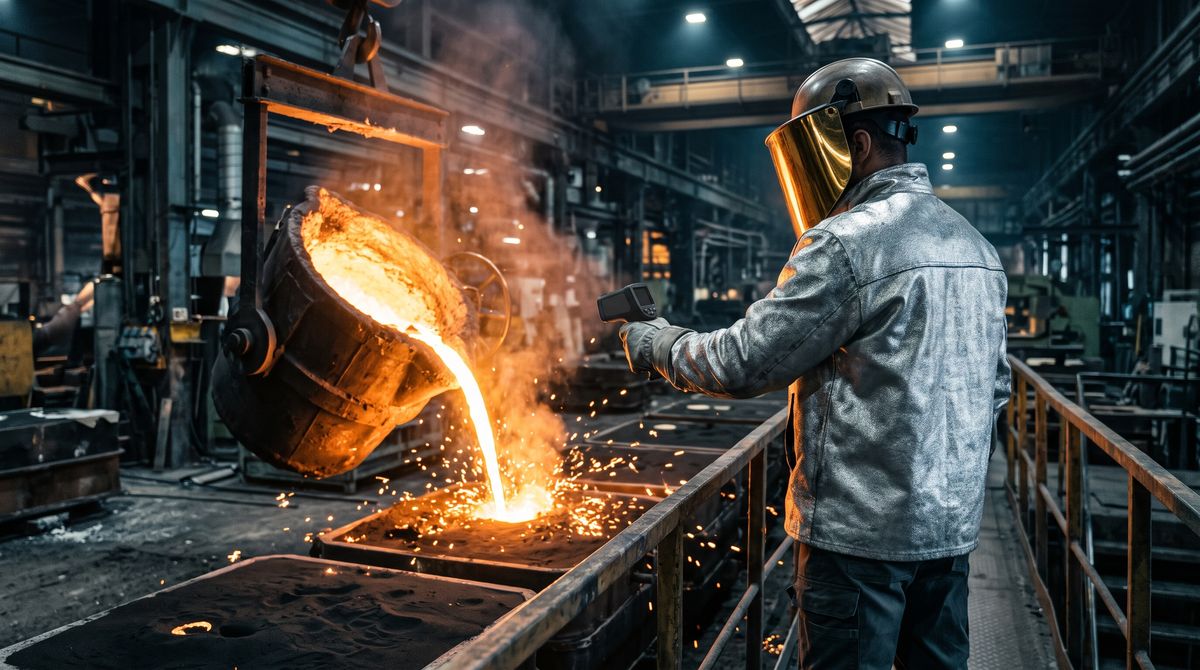
Foundry worker in an aluminized suit using a handheld pyrometer to measure molten metal temperature during pouring
Foundry

Pouring temperature read from a safe distance

For the melt itself, the immersion probe remains the reference, but it uses up a tip with every reading and forces you to get close. A pyrometer reads the pouring stream or the surface from a few meters away, continuously. On metals a short wavelength around 1 µm is the better choice, because the error caused by uncertain emissivity is much smaller than in the 8-14 µm band.

  • The stream leaving the ladle or furnace, measured without contact at every pour.
  • Forgings, ingots and billets before the next processing step.
  • Furnace and ladle walls during preheating, without probes to position.
Choosing the instrument

Handheld or fixed pyrometer, single- or two-wavelength?

The name is the same, but the choice depends on where you measure and how difficult the material is. The table compares the most common types and adds the thermal camera for when you need to find the hot spot rather than measure a known one.

Comparison of handheld, fixed single-wavelength, two-color and fiber-optic pyrometers and the thermal camera
TypeHow it is usedWhere it works bestStrengthsLimits
Handheld pyrometerHeld in hand, with sighting optics or a laser pointerMaintenance, spot checks, acceptance testsFast, ready to use, handy across departmentsReading depends on the operator, no continuous monitoring
Fixed single-wavelength pyrometerMounted on the line, with analog or digital outputStable processes with a known materialContinuous measurement with response times of a few millisecondsSensitive to changing emissivity, dust and steam
Two-color (ratio) pyrometerFixed, compares two nearby wavelengthsSteel mills, forging, small or smoky targetsHandles changing emissivity and a partly blocked view betterCosts more and usually works only from a few hundred degrees up
Fiber-optic pyrometerOptical head separate from the electronicsInduction heating, tight spaces, very hot areasElectronics stay away from heat and electromagnetic noiseThe fiber has to be protected and routed carefully
Thermal cameraImage of thousands of pointsFinding the hot spot, temperature profilesSees the whole scene at onceCosts more and is harder to integrate into process control

If the process is stable and the material has a high, constant emissivity, such as oxides, glass at the right wavelength or most plastics, a single-wavelength pyrometer is enough. When you work on shiny metals or surfaces that change during the process, or when smoke, steam or dust sit between you and the part, a two-color pyrometer gives you a much steadier reading.

Applications

Where industrial pyrometers are used.

Foundries

Temperature of the pouring stream, of the metal in the ladle and of the molds before casting. A consistent reading helps reduce cold shuts and misruns.

Steel mills and rolling mills

Billets, slabs and strip leaving the furnace and along the rolling train. Fixed pyrometers dominate here, often two-color and in cooled housings.

Forging and heat treatment

Part temperature before forging, during quenching and tempering, including induction heating. A fast reading lets you reject parts outside the process window right away.

Glass

For the glass surface, wavelengths around 5 µm are used, where glass is opaque and the pyrometer does not read through the material. Typical uses are gobs, forming, tempering and annealing.

Plastics and film

Thin films are partly transparent to infrared, so you need narrow bands where the material absorbs, for example 3.43 µm for polyethylene and polypropylene. Common uses are extrusion and thermoforming.

Furnaces and combustion

Furnace walls, refractory and product seen through clean flames, with pyrometers around 3.9 µm, a band where combustion gases interfere very little.

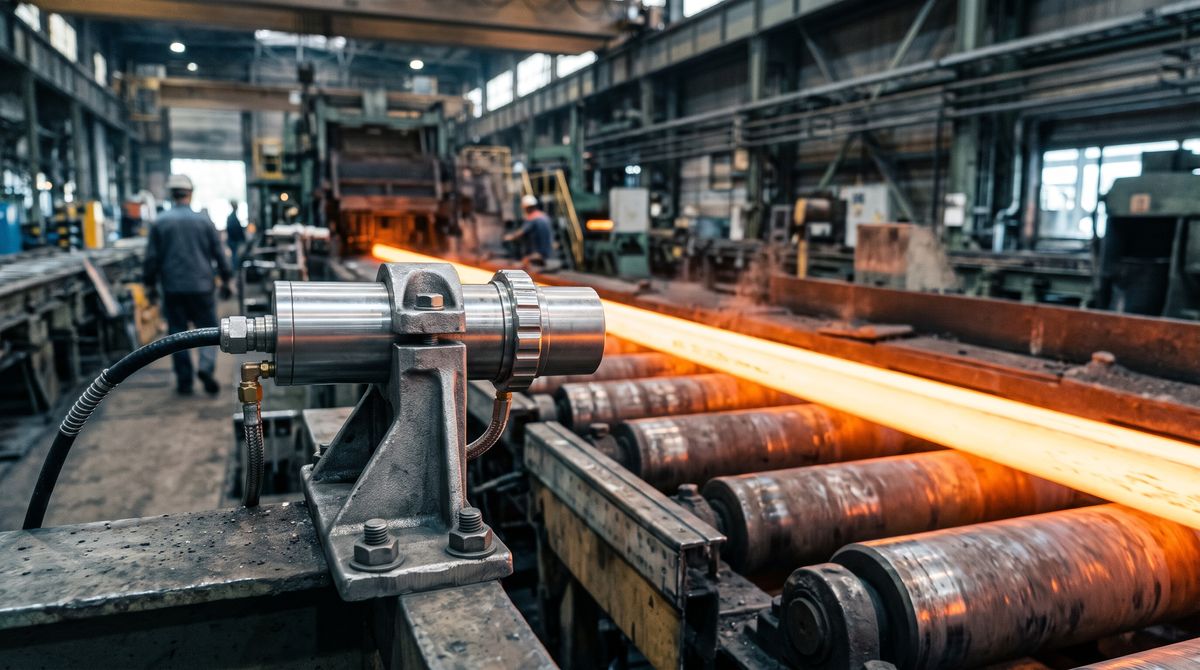
Fixed pyrometer with an air purge collar aimed at a glowing hot steel bar in a rolling mill
Process control

The fixed pyrometer becomes a sensor on the line

Mounted on the line, the pyrometer sends the temperature to the PLC through a 4-20 mA output or a fieldbus and can trigger an alarm or adjust the furnace. In hot, dirty environments it works inside a water-cooled housing, with an air purge in front of the optics that keeps dust and condensation away.

  • Analog and digital outputs for direct connection to the control system.
  • Cooled housings and air purge for the toughest environments.
  • Sighting optics, laser pointer or video to align the spot right on the part.

Which pyrometer does your process need?

If the part moves, if there is smoke or steam or if the surface is shiny, telling us up front changes the choice. You get a quote for a pyrometer that actually reads your material.

  • Handheld and fixed pyrometers
  • Technical support in Italy
Technical criteria

How to choose an industrial pyrometer.

Before looking at price, it pays to pin down a few process details. These are the ones we ask you for so we can suggest a model suited to your part.

Temperature range

Every pyrometer is optimized for a range. An instrument that goes from room temperature to 1,000 °C usually loses accuracy at both ends, so choose one centered on the temperatures you measure most often.

Wavelength

It has to match the material. Short wavelengths for metals, the 8-14 µm band for non-metals at low temperatures, and narrow bands for glass, plastics and measurement through flames.

Distance-to-spot ratio

It tells you how large the spot is at a given distance, for example 50:1 means about 2 cm in diameter at 1 m. The part must fill the whole spot, otherwise a single-wavelength pyrometer also reads the background and gets it wrong.

Emissivity

This is the parameter behind most errors. Set it for the material and its real surface, oxidized, shiny or rough, and check it at least once against a contact measurement.

Response time and outputs

Fast-moving parts need a few milliseconds and functions such as peak hold. For line use, check outputs, power supply and the communication protocol already used in your plant.

Environment and calibration

Ambient temperature around the sensor, dust, steam and vibration decide the housing, cooling and air purge. Also ask for the calibration certificate and whether the instrument can be recalibrated at an accredited lab.

If you need to find the hot spot over a whole area rather than measure a known point, you need an industrial thermal camera. To check alloy composition in the foundry there is material analysis with a handheld XRF, and the other instrument categories are listed in DIPITECH solutions.

Buy or outsource

Buy a pyrometer or outsource the measurement?

A handheld pyrometer is an everyday, low-cost instrument, so it is usually bought and kept in the department. A fixed pyrometer is bought together with a mounting design, because it has to be chosen with the measuring position, the housing and the connection to process control.

An outside service makes sense mainly for periodic calibration and comparison checks, when you need a traceable certificate. Renting pyrometers is uncommon and we only consider it for short measurement campaigns.

The DIPITECH approach

The material picks the wavelength.

A steel billet at 1,200 °C reads well at short wavelengths, while a polyethylene film at 180 °C can only be read in the polymer’s absorption band, around 3.43 µm. That is why the first thing we ask is what you are measuring.

What to send us for an assessment

  • Material to measure and surface condition (oxidized, shiny, rough).
  • Temperature range and most frequent value.
  • Measuring distance and size of the part or area to read.
  • Whether the part is stationary or moving, and how fast.
  • Environment: dust, steam, flames, temperature around the sensor.
  • Whether you need a handheld unit or a fixed one with output to the PLC.
FAQ

Pyrometer FAQ

What is an industrial pyrometer used for?

To measure the temperature of parts and materials without touching them, when they are too hot, moving, energized or hard to reach. It is used in foundries, steel mills, forging, heat treatment, glass and plastics, and in many maintenance checks.

How much does an industrial pyrometer cost?

It depends on the temperature range, wavelength, optics and type. A handheld unit for maintenance costs much less than a fixed two-color pyrometer with a cooled housing or fiber optics. Tell us the material, temperature and distance, and we will send you a quote for the model your process needs.

Does a laser pyrometer measure with the laser?

No. The laser is only for aiming and showing you where you are pointing, while the measurement relies on the infrared radiation emitted by the part. Keep in mind that the laser dot does not always match the center of the spot and does not tell you how large the measured area is.

What is an optical pyrometer?

Originally it was the disappearing-filament pyrometer, where the operator visually matched the brightness of the glowing part against a calibrated filament. Today the term usually means an infrared pyrometer with precision optics and a sighting eyepiece, suited to small and distant targets.

What is the difference between single- and two-wavelength pyrometers?

A single-wavelength pyrometer measures energy in one band and depends directly on the emissivity setting. A two-color pyrometer compares two nearby bands and calculates temperature from their ratio, so it copes better with changing emissivity, dust, steam and targets smaller than the spot, as long as emissivity changes the same way in both bands.

How often should a pyrometer be calibrated?

No single interval is set by law. Quality systems usually call for a yearly check, or more often if the reading decides product acceptance, using a blackbody comparison or a traceable calibration certificate from an accredited lab.

How do I request a quote?

Message us on WhatsApp, by email or through the form with the material, temperature range, distance, part size and whether you need a handheld or fixed unit. We reply within 24 hours with the right model and a quote.

Application support

Support with your choice, before and after you buy.

We help you choose a pyrometer for the part and the process you need to control, and after purchase you get technical support in Italy, including help with emissivity settings.

Contact

Let’s find the right pyrometer for your process.

For a foundry pour or an extruded film we need two facts, material and temperature, and with those we suggest a model and send a quote.

Application request

Tell us what you need to check.

Describe what you are looking for and where; add photos or plant data if you have them.

WhatsApp