Solutions • Thermography • Predictive maintenance

Professional thermal camera for electrical, mechanical and process maintenance.

A thermal camera shows you in seconds a terminal running hot, a struggling bearing or worn furnace refractory, without shutting the plant down. Resolution, sensitivity and lenses depend on what you inspect and from how far away, and that is where we start when helping you choose.

Reply within 24 hours · Purchase or rental · Technical support in Italy

In short

What is a thermal camera?

It is a camera that measures the infrared radiation emitted by objects instead of visible light, and turns it into an image where each pixel corresponds to a temperature. Most industrial thermal cameras work between roughly 7.5 and 14 µm with an uncooled microbolometer sensor, so you can find overheating and heat loss without touching anything and with the plant running.

We help you choose the right thermal camera: reply within 24 hours

How much does a professional thermal camera cost?

A compact camera for maintenance rounds and a 640 × 480 model with interchangeable lenses can differ in price several times over. Tell us what you need to inspect and from what distance, and we will send you a quote with the resolution you need, without paying for pixels you will not use.

  • Reply within 24 hours
  • Purchase or rental
  • Technical support in Italy
Infrared thermography

How an industrial thermal camera works.

Every object above absolute zero emits infrared radiation, and how much it emits depends on its temperature and on the emissivity of its surface. The camera lens, made of germanium or chalcogenide glass because ordinary glass blocks thermal infrared, focuses this radiation onto a microbolometer array. The software then converts each pixel's signal into a temperature, taking into account the emissivity, reflected temperature and distance you set.

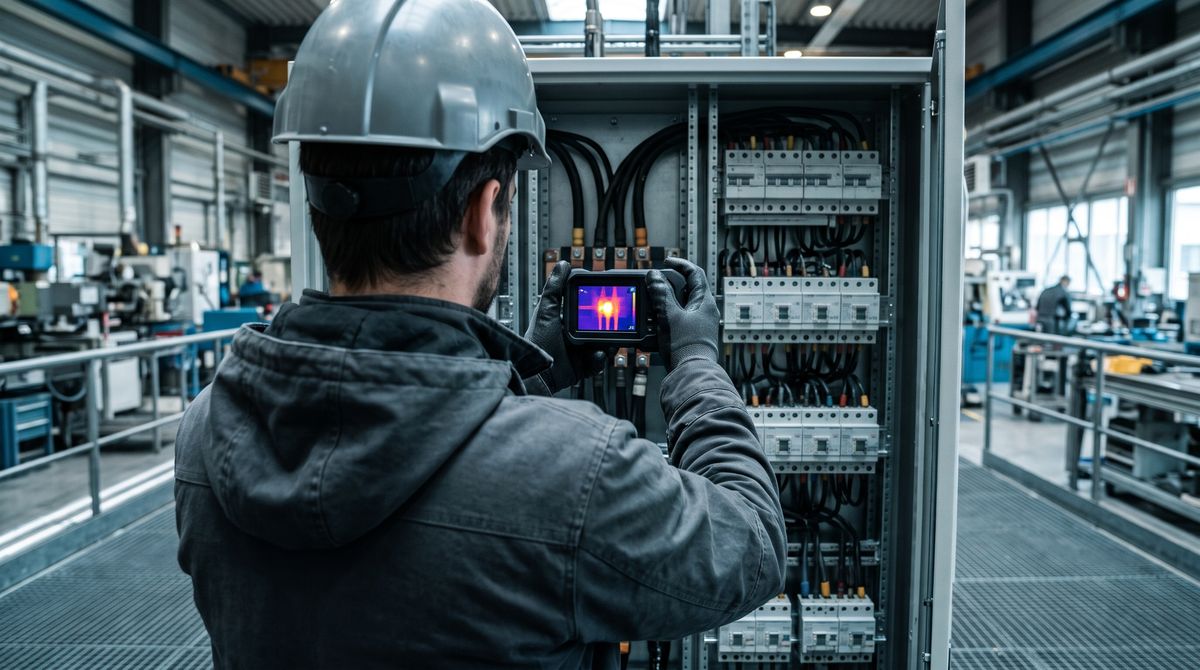
Technician using a handheld thermal camera to inspect the connections of a low-voltage electrical panel in a plant
Electrical maintenance

A loose terminal shows up before it burns

A loose or oxidized connection raises contact resistance and heats up through Joule losses. On the thermogram it appears as a spot hotter than the neighboring phases, and comparing identical components under the same load is the most reliable way to judge severity. That is why you inspect with the equipment under load, ideally no less than 40% of rated load, as electrical maintenance guidelines suggest.

  • You check panels, busbars, breakers and terminals without de-energizing and from a safe distance.
  • Each anomaly is saved with a thermal image, a visible photo and the temperature, ready for the report.
  • By repeating the round every year you compare thermograms and see which components are getting worse.
Choosing the instrument

Which thermal camera do you need: compact, professional, fixed or cooled?

The same name covers instruments that differ widely in price and performance. The table compares the four families used in industry and adds the pyrometer, which suits anyone who always measures the same spot.

Comparison of compact, professional, fixed and cooled thermal cameras and the pyrometer
TypeTypical resolutionWhere it is usedStrengthsLimits
Compact thermal camera160 × 120 or 320 × 240 pixelsMaintenance rounds, low-voltage panels, heating systemsLight, simple, affordableFixed lens and little detail on small or distant targets
Professional thermal cameraFrom 320 × 240 to 640 × 480 and higherPredictive maintenance, medium and high voltage, refractory, R&DInterchangeable lenses, high sensitivity, analysis and reporting softwareCosts more and needs a trained operator
Fixed thermal cameraFrom 160 × 120 to 640 × 480Continuous monitoring of processes, furnaces and conveyors, early fire detectionMeasures around the clock and sends alarms to the control systemRequires a mounting, protection and integration design
Cooled thermal cameraCooled MWIR sensor, typically 640 × 512Research, very fast events, gas imagingVery high speed and sensitivityMuch higher price and cooler maintenance
PyrometerA single spotProcess measurement on a known targetAffordable, fast, easy to connect to a PLCNo image, cannot find the hot spot on its own

For plant maintenance the most common choice is a portable professional camera around 320 × 240 pixels with at least two lenses, because it covers panels, motors and steam lines. If you work on substations, overhead lines or large furnaces seen from far away, it pays to step up in resolution or add a telephoto lens. A fixed camera comes in when a temperature has to be watched continuously rather than during an inspection round.

Applications

Where thermal cameras are used in industry.

Electrical panels and substations

Loose terminals, unbalanced phases, fuses and breakers running hot, at low and medium voltage. It is the most common thermographic inspection and often the first one worth scheduling.

Motors and mechanical parts

Bearings, misaligned couplings, gearboxes and slipping belts run hotter than normal. Thermography works alongside vibration analysis in condition monitoring, following the general procedures of ISO 18434-1.

Refractory and furnaces

On the shell of furnaces, ladles, boilers and ducts, a hot spot points to worn or cracked refractory. Regular checks help you plan relining at the right shutdown.

Steam and process fluids

Blocked steam traps, leaking valves, clogged pipes and damaged insulation. On steam lines the thermal camera works well together with an acoustic camera.

Industrial buildings

Thermal bridges, air leakage and moisture in warehouses and offices, using the qualitative method of EN ISO 6781-1, which replaced EN 13187. You need a large enough temperature difference between inside and outside.

Solar PV plants

Defective cells, bypass diodes and connections running hot on ground-mounted and rooftop plants, drones included. IEC TS 62446-3 describes thermography on modules in operation.

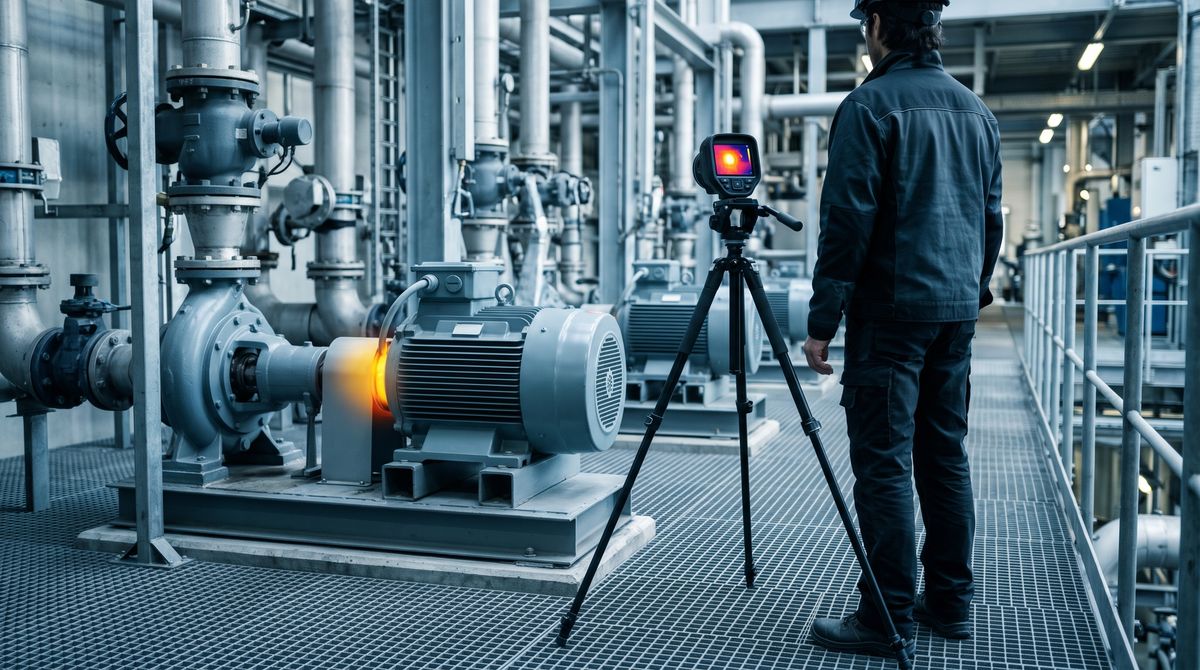
Thermal camera on a tripod inspecting electric motors and centrifugal pumps in an industrial pumping station
Predictive maintenance

Motors, pumps and bearings checked on every round

On an electric motor the thermal camera shows bearings, frame, terminal box and coupling in a single image. One side of the coupling hotter than the other suggests misalignment, while an evenly hot frame points to overload or poor ventilation. Comparing identical machines under the same operating conditions makes the diagnosis far more solid than a single reading.

  • Bearings, couplings and gearboxes on motors, pumps, fans and compressors.
  • Conveyor belts, rollers and belt drives that slip or run poorly.
  • Twin machines compared side by side to find out which one is failing first.

Which thermal camera does your plant need?

For a shutdown or a one-off inspection campaign you can also rent one. Tell us what you need to inspect and we will send you a quote to rent or buy.

  • Electrical, mechanical and process
  • Technical support in Italy
Technical criteria

How to choose a professional thermal camera.

Datasheets list dozens of numbers, but only a few matter for industrial use, and those are what we ask you about before suggesting a model.

Resolution and IFOV

Resolution alone says little. What counts is the instantaneous field of view (IFOV, in milliradians), meaning how large an area a single pixel sees at your distance. To measure a temperature properly the target has to cover several pixels, usually at least 3 × 3.

Thermal sensitivity (NETD)

It is the smallest temperature difference the camera can tell apart from sensor noise. Values below 50 mK are fine for electrical work, while below 30 mK helps with mechanical, building and subtle anomalies.

Temperature range

A few hundred degrees are enough for panels and motors. Furnaces, refractory and metals need high ranges, up to 1,500 or 2,000 °C with dedicated filters. Check the stated accuracy in the range you will actually use.

Lenses

A wide-angle lens helps in panels and tight spaces, a telephoto lens for substations, overhead lines and stacks. Interchangeable lenses cost money, but they save you from buying a second camera.

Emissivity and metals

Polished copper, aluminum and stainless steel are highly reflective with low emissivity, so readings can be off. You need emissivity and reflected temperature correction, and an operator who knows when to trust the number.

Software and reporting

The real time sink comes after the round, going from images to the report. Look at PC analysis, report templates, side-by-side visible photos and radiometric video recording.

For compressed air and gas leaks, which a thermal camera usually cannot see, look at the acoustic imaging camera. If you only need to measure a known spot on a process there is the industrial pyrometer, while thermography as a test method belongs to non-destructive testing. For other instrument families, start from the solutions index.

Buy, rent or outsource

Buy, rent or hire a thermography service?

If you have several sites, a predictive maintenance program or panels and motors to inspect every year, buying the camera usually makes sense. The value lies in repetition, because thermograms of the same component compared over time tell you far more than a single image.

Renting makes sense for a limited campaign, such as a plant shutdown, an acceptance test or an energy audit. An outside service is still useful when you need a report signed by an operator qualified to ISO 9712 or ISO 18436-7, a requirement that some specifications and insurers set.

The DIPITECH approach

Distance decides the camera.

A low-voltage panel at one meter can be checked with modest resolution, while a furnace shell at thirty meters needs more pixels, a narrow lens and a high range. The first question is always what you are looking at and from where.

What to send us for an assessment

  • What you want to inspect: panels, motors, refractory, steam, buildings, solar PV.
  • Typical distance and size of the smallest components to measure.
  • Highest temperature you need to read.
  • Whether you need a handheld camera or a fixed one on the process.
  • Who will use it and whether they already have thermography training.
  • Whether you prefer to buy or rent.
FAQ

Thermal camera FAQ

What is a thermal camera used for in industry?

It finds thermal anomalies without contact and with the plant running. The most common ones are hot electrical connections, stressed bearings and motors, worn refractory, steam leaks and damaged insulation. Together with vibration analysis it is one of the main predictive maintenance tools.

How much does a professional thermal camera cost?

The price depends mainly on sensor resolution, thermal sensitivity, temperature range, lenses and software. A compact camera for maintenance rounds costs a fraction of a 640 × 480 model with a telephoto lens, and a cooled camera sits in another price bracket altogether. Tell us what you need to inspect and we will send a quote for the right configuration, rental included.

What is the difference between a thermal camera and a pyrometer?

A pyrometer measures the average temperature of a single spot, the one you aim at. A thermal camera measures thousands of points at once and shows you the image, so it finds the hottest spot on its own. The pyrometer is ideal for always checking the same target on a process, the thermal camera for searching anomalies when you do not know where they are.

What resolution does an industrial thermal camera need?

For low-voltage panels and motors a few meters away, 160 × 120 or 320 × 240 pixels are fine. For substations, overhead lines, large furnaces or small components seen from far away, 640 × 480 or a telephoto lens is the better choice. The right calculation starts from the distance and the size of the smallest component you need to measure.

Can a thermal camera measure temperature through glass?

No. Ordinary glass and acrylic are opaque to thermal infrared, so the camera only sees the glass surface. Closed electrical panels can be fitted with inspection windows made of infrared-transparent materials, which have to be accounted for when correcting the measurement.

Do you need a certification to perform thermography?

Not to use the camera. To sign thermography reports, many settings require an operator qualified to ISO 9712 for the thermographic method (TT) or to ISO 18436-7 for machinery condition monitoring. Keep it in mind when choosing between buying a camera and hiring a service.

How do I request a quote?

Message us on WhatsApp, by email or through the form, saying what you want to inspect, your working distance, the highest temperature and whether you need a handheld or fixed camera. We reply within 24 hours with the right configuration and a quote.

Application support

Support with your choice, before and after you buy.

We help you choose a thermal camera for the inspection you need to do, and you get technical support in Italy for your first surveys, whether you buy or rent.

Contact

Let’s find the right thermal camera for your plant.

From electrical panels to furnaces, tell us about your site and we send you the configuration and a quote.

Application request

Tell us what you need to check.

Describe what you are looking for and where; add photos or plant data if you have them.

WhatsApp