Solutions • Collaborative robotics • Automation

Cobots, the collaborative robots that work alongside your operators.

A cobot is a lightweight robot arm designed to share space with people and to be programmed without a robotics expert always on hand. Before any quote, we check with you whether your application suits a cobot, which payload and reach you need and what has to be assessed on safety.

Reply within 24 hours · Quote for your application · Technical support in Italy

In short

What is a cobot?

Cobot is short for collaborative robot, an industrial robot designed to work in the same space as operators. It has sensors and safety functions that limit force, speed and power, it is often programmed by moving it by hand or from a tablet, and most models carry payloads from a few kilograms to about 30 kg. It is still a machine, and every application needs a risk assessment before guarding is reduced.

We help you choose the right cobot: reply within 24 hours

How much does a cobot cost?

The arm is only part of the cost. Gripper or tool, base, sensors, any vision system, programming and risk assessment can add up to as much as the robot itself. That is why we build the quote around the complete application, starting from the cycle you describe.

  • Reply within 24 hours
  • Quote for your application
  • Technical support in Italy
Collaborative robotics

How a collaborative robot works.

A cobot usually has six axes, like an industrial robot, but its motors, gearboxes and controller are designed to sense contact and stop. Safety functions continuously monitor force, speed and position, and you can set zones where the arm slows down when someone comes close. Programming is usually done from a tablet with a graphical interface, or by guiding the arm by hand and recording the points.

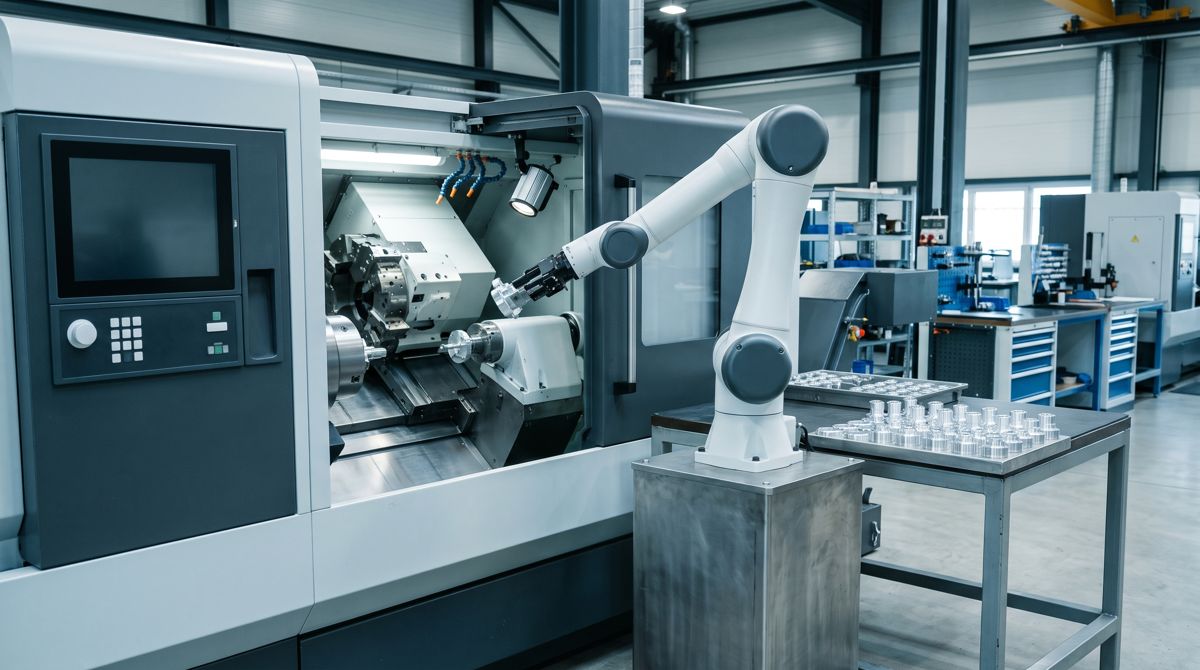
Collaborative robot on a pedestal loading a metal part into a CNC lathe
Machine tending

The most common job, loading and unloading a machine tool

Placed next to a machining center or lathe, a cobot takes the blank from a tray or drawer, loads it into the machine, waits for the cycle and unloads the finished part. The operator prepares the trays and checks the parts, while the machine keeps running through breaks and, with a good stock of blanks, for part of the shift unattended.

  • The cobot talks to the CNC control to open the door and start the cycle.
  • On a mobile base it moves from one machine to another using a new position reference.
  • Repeatability, typically a few hundredths of a millimeter, is enough for most vise or chuck loading.
Choosing the solution

Cobot or industrial robot?

Before picking a model, it helps to know whether your application really has to share space with people. The table compares the cobot with the closest alternatives, using indicative values.

Comparison of cobots, industrial robots in a guarded cell, industrial robots with scanner-based safety and mobile manipulators
SolutionPayload and speedSafetyStrengthsLimits
CobotUp to about 30 kg, reduced speed when people are nearbyPower and force limiting, reduced guarding after risk assessmentEasy programming, minimal footprint, easy to relocateSlower than an industrial robot, limited payload
Industrial robot in a cellFrom a few kilograms to over a ton, full speedFencing, light curtains or scanners that stop the robotHigh rates, heavy loads, heavy-duty serviceNeeds space for the cell and more specialized programming
Industrial robot with scannersMedium payloads, slows or stops when you enter the areaLaser scanners and separation monitoringFull speed when the area is clearMore complex safety design
Mobile manipulator (cobot on an AMR)Cobot payloads, across several stationsCobot and vehicle safety assessed togetherOne robot serves several machines or stationsPositioning accuracy handled with references or vision

For tending one or two machines, screwdriving and light pick and place, a cobot is often the fastest option to put into service. If the cycle is fast, parts weigh more than a few dozen kilograms or nobody should enter the area, an industrial robot in a cell delivers more for the same budget. In between are scanner-based solutions that slow the robot when someone approaches, useful when you need full speed and occasional operator access.

Applications

Where cobots are used.

CNC machine tending

Loading and unloading machining centers, lathes, grinders and press brakes. This is the application with the easiest payback to calculate, because it adds productive hours to the machine.

Pick and place and packaging

Picking from conveyors or trays and placing into boxes and thermoformed trays, often with a camera that detects where each part sits.

Screwdriving and assembly

Torque and angle controlled screwdrivers on the wrist, component insertion, gluing and sealant dispensing.

Welding

MIG/MAG and TIG welding on small and medium batches. The welder teaches the path by guiding the torch and the cobot repeats it, while fumes, screens and arc hazards are managed as at any welding station.

Palletizing

Compact end-of-line cells for light cases and slow lines, with two pallet stations so production does not stop at pallet change.

Quality control

The cobot carries a camera, sensor or probe to the points to be checked, or presents the part to a measuring station in the same position every cycle.

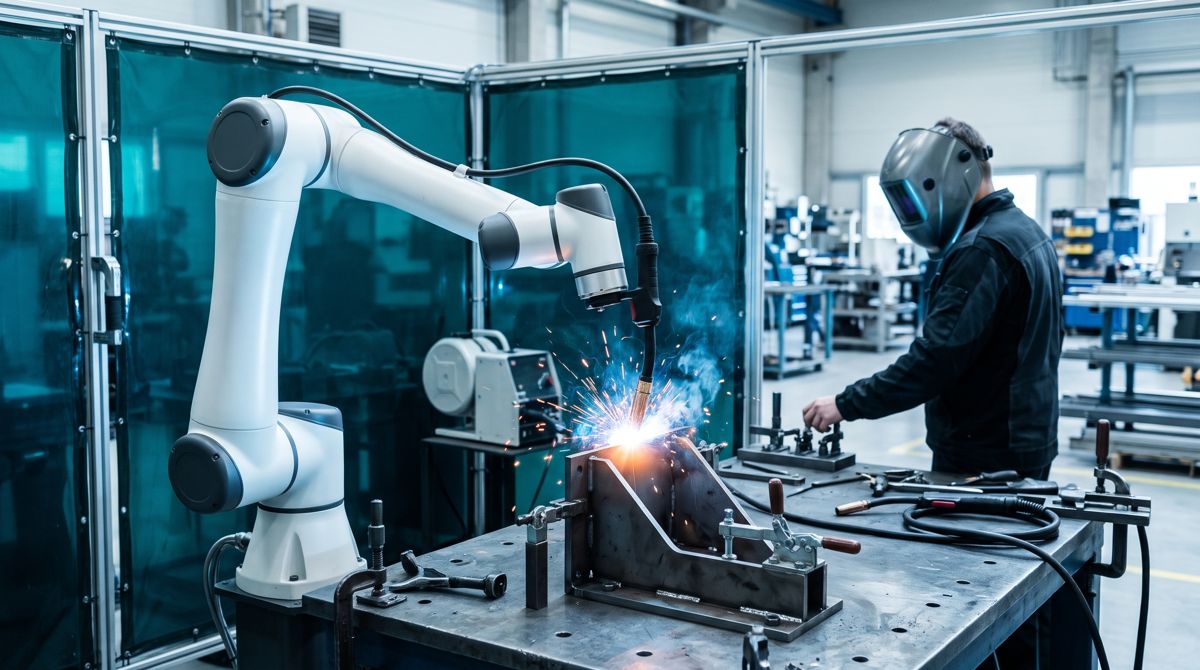
Cobot holding a MIG welding torch welding a steel bracket on a fixture table while the welder prepares the part
Cobot welding

Collaborative welding on small and medium batches

In welding, a cobot shines when batches change often and a traditional robot cell would never pay for itself. The welder stays in charge of parameters and quality, prepares parts on the fixture and leaves the repetitive welds to the cobot. Safety here is mostly about the arc and the fumes, so screens, extraction and eye protection are still needed with a collaborative robot.

  • Torch and power source integrated with the robot controller.
  • Fixtures and tables that put the part in the same place every time.
  • Seam finding with sensors, useful when parts have wide tolerances.

Is your application right for a cobot?

Describe the cycle, part weights and workstation. Those three things already show whether a cobot can keep up with your rate or you need a robot in a cell, and we request quotes on that basis.

  • Machine tending, welding, assembly
  • Technical support in Italy
Technical criteria

How to choose a cobot.

On cobot datasheets the numbers look similar, but payload, reach and speed change a lot once you bring them to your own workstation.

Real payload

The rated payload includes the gripper, so subtract its weight, and it drops when the part's center of gravity is far from the flange. Always leave a margin.

Reach and work envelope

Cobot reach typically runs from about half a meter to about two meters. Check that the arm reaches every point with a comfortable wrist orientation, beyond the straight-line distance.

Speed and cycle time

In collaborative mode the cobot slows down to stay within the allowed force and pressure limits. Estimate cycle time with those limits, because the top catalog speed often cannot be used.

Repeatability and accuracy

Cobot repeatability is typically a few hundredths of a millimeter, enough for machine loading and assembly. Very tight insertions call for force sensing or vision.

Gripper, tools and integration

Grippers, vacuum cups, screwdrivers and welding torches are available for almost every model. How the cobot talks to the machine tool, the PLC or the vision system matters too.

Safety and risk assessment

ISO 10218-1 covers the robot and ISO 10218-2 the robot application. The force and pressure limits for contact with people, described in ISO/TS 15066, are carried into the 2025 edition of ISO 10218-2. A sharp tool or a part with sharp edges can require guarding even with a cobot.

For end-of-line work, the comparison of the different types is on the automatic palletizer page. If you need a robot that moves between several stations, mobile manipulators and AMRs are on the industrial robotics and material handling page, and the other categories are listed in DIPITECH solutions.

Purchase and commissioning

Just the arm or the complete application?

You can buy the cobot alone and develop the application in house, if someone in engineering has time for it, or ask for a complete application with gripper, base, programming and risk assessment. The second route costs more up front but gets the robot into production sooner. Either way, CE marking of the whole assembly is the responsibility of whoever builds the application, and with Regulation (EU) 2023/1230 applying from January 20, 2027, this step should be planned at the order stage.

Our role is to help you define the application, compare quotes and coordinate the technical discussion with the manufacturer or integrator. Requirements and deadlines for capital equipment incentives change often, so check them with your advisor before ordering. We will help you collect the technical datasheets you need from the manufacturer.

The DIPITECH approach

The cycle you automate comes before the model.

We start with the cycle you want to automate. The same cobot can be perfect for a grinder and wrong for a fast press.

What to send us for an assessment

  • What the robot has to do and the current cycle time.
  • Weight, size and material of the parts.
  • Machines or stations involved and how they are controlled.
  • How many people work in the area and when they enter it.
  • Photos or a short video of the current workstation.
  • Work shifts and production target.
FAQ

Cobot FAQ

How much does a cobot cost?

The price of the arm alone depends mostly on payload and reach, but in a complete application the gripper or tool, base, sensors, vision, programming and risk assessment also count. These items often cost as much as the robot. Describe your application and we will prepare a quote for the complete solution, based on proposals from suitable manufacturers.

What is the difference between a cobot and an industrial robot?

Cobots are designed to work in the same space as people, with functions that limit force, speed and power, and they are easier to program. An industrial robot works faster and with heavier loads, but usually inside a guarded cell. The choice depends on cycle rate, part weight and how often the operator needs to enter the work area.

Can a cobot work without guarding?

Only if the risk assessment of the application shows it can. The cobot has its own safety functions, but the gripper, part, tool and speed all change the outcome. ISO 10218-2, which in its 2025 edition takes over the ISO/TS 15066 limits, provides the criteria, and in many cases scanners or light guarding are enough instead of full fencing.

Can a cobot be used for welding?

Yes, MIG/MAG and TIG welding is one of the most common applications, especially on small and medium batches. The welder teaches the path by guiding the torch, the cobot repeats it consistently and the welder takes care of parameters, fixtures and inspection. Screens, fume extraction and arc protection are still required.

How much weight can a cobot lift?

Most cobots carry from a few kilograms to about 30 kg, and some larger models are built for palletizing. The rated value includes the gripper and drops when the part's center of gravity is far from the flange, so choose with a margin.

Do you need an expert programmer to use a cobot?

For simple applications a trained in-house technician is usually enough, because many cobots are programmed from a tablet with a graphical interface or by guiding the arm by hand. Integrating vision, machine tool communication or complex cycles still takes automation skills, either in house or from the manufacturer building the application.

How do I request a quote?

Message us on WhatsApp, by email or through the form and describe the cycle to automate, part weights, the machines involved and the cycle time, ideally with photos or a short video of the workstation. We reply within 24 hours and collect proposals from manufacturers for the right application.

Application support

Support with your choice, before and after you buy.

We help you choose a cobot for the application you need to automate, and you have technical support in Italy in the discussion with the manufacturer, including after commissioning.

Contact

Let’s find the right cobot for your production.

With the cycle, part weights and a photo of the workstation we can quickly tell whether a cobot makes sense and which quotes to request.

Application request

Tell us what you want to automate.

Describe the cycle, part weights and machines involved; add photos or a video of the workstation if you have them.

WhatsApp