Solutions • End of line • Palletizing

Automatic palletizer for your end of line: robotic, cobot, gantry or layer.

An automatic palletizer picks cases, bags or bundles from the conveyor and places them on the pallet following the pattern you set, shift after shift. Together we work out which type can keep up with your throughput and formats, and on that basis we prepare the request for manufacturers.

Reply within 24 hours · Quote for your end of line · Technical support in Italy

In short

What is a palletizer?

It is the end-of-line machine that builds pallets automatically. It takes products from a conveyor, orients them and places them layer by layer following a set pattern, often adding slip sheets and empty pallets too. It can be an articulated robot, a cobot, a cartesian gantry or a layer palletizer, and the choice depends mainly on throughput, case weight and available space.

We help you choose the right palletizer: reply within 24 hours

How much does an automatic palletizer cost?

A small cobot cell and a robot feeding three pallet stations with automatic pallet change are very different investments, and much of the cost sits in the gripper, conveyors, guarding and software. With your products, throughput and a layout of the area we request quotes that all describe the same cell, and compare them with you line by line.

  • Reply within 24 hours
  • Offers from manufacturers
  • Technical support in Italy
Automatic palletizing

How an automatic palletizer works.

The cycle starts at the infeed conveyor, where products arrive in line and, if needed, are turned to match the layer pattern. The machine picks them one at a time or in groups, places them on the pallet and, once a layer is complete, can lay a cardboard slip sheet before starting the next one. When the pallet is full a roller conveyor takes it to the stretch wrapper and a pallet dispenser puts an empty one in place.

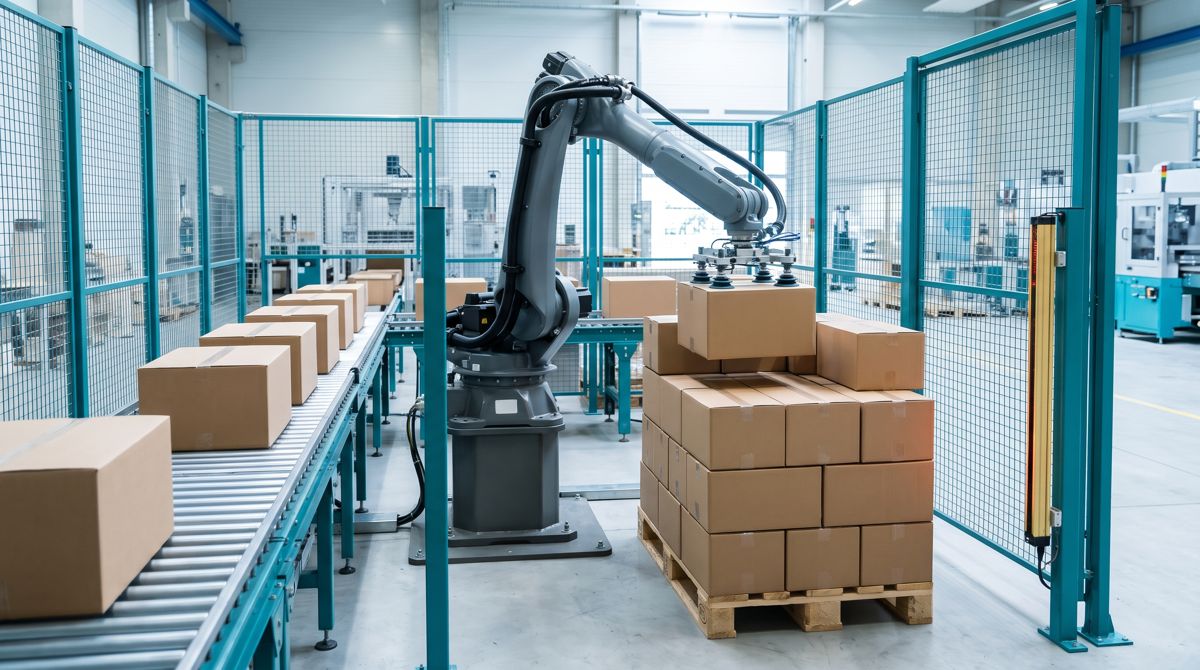
Articulated palletizing robot stacking cardboard cases on a pallet at the end of a packaging line inside a fenced cell
Palletizing robot

The four-axis robot, the most common choice at end of line

Robots built for palletizing usually have four axes, since the product only needs to go up, down, across and rotate, and they handle wrist payloads from a few dozen kilograms to several hundred. One robot can serve two lines and two pallets at once. The gripper is chosen for the product, with vacuum cups for cartons, forks or fingers for bags and clamps for bundles.

  • Format changes are made by loading a recipe on the operator panel, with no mechanical work.
  • Pallet patterns are drawn in dedicated software, often by the line operator.
  • It takes less floor space than a layer palletizer, which in turn handles higher rates.
Choosing the type

Articulated robot, cobot, gantry or layer palletizer?

These four families cover almost every end of line. The table compares them on the parameters that weigh most in the choice, with indicative values you should always check on your own product.

Comparison of cobot palletizers, articulated robot palletizers, cartesian gantry palletizers and layer palletizers
TypeTypical productsIndicative rateStrengthsLimits
Cobot palletizerLight cases, usually under 15-20 kg including the gripperLow, suited to one slow lineCompact, reduced guarding if the risk assessment allows it, easy to move between linesLimited payload and pallet height
Articulated robotCases, bags, bundles, drumsMedium, across several lines with multi-pick grippersFlexible, fast format changes, several lines in one cellNeeds a guarded cell with fencing and light curtains
Cartesian gantryBags, bundles, crates, heavy productsMediumRigid structure, large working area, many pallet stations under one gantryTall structure, layout changes take more work
Layer palletizerCases, bundles and bags on fast linesHigh, because it forms a full layer before placing itHandles the highest rates with regular productsLarger footprint and investment, best with few formats and high volumes

If only a few cases per minute come off the packaging machine and space is tight, a cobot palletizer is often the simplest answer, partly because it can be moved to another conveyor with little effort. As the rate grows or cases get heavier, the articulated robot takes over, and with a multi-pick gripper it can serve two or three lines at once. The cartesian gantry is useful with very heavy products or many pallet stations side by side, while the layer palletizer remains the machine for high-speed lines with few formats, as is often the case in beverage and building materials.

Applications

Where automatic palletizers are used.

Food and beverage

Cartons, bottle bundles and trays, often with many formats running through the same machine. Fast format changes and easy cleaning matter here, because the end-of-line area is washed and inspected often.

Bags of powders and granules

Cement, animal feed, fertilizers, chemicals and flour. A bag changes shape, so it has to be flattened before pickup and then placed with a fork or finger gripper that supports it without tearing.

Pharma and cosmetics

Cartons packed into light cases and lines with short batches. This is where a cobot palletizer fits well, because it takes little space and can be reconfigured quickly.

Ceramics, building materials and metal

Heavy and irregular loads such as crates, coils and bundled profiles. For these products a cartesian gantry or a high-payload robot handles the weight with margin.

Logistics and distribution centers

Mixed pallets built from cases of different SKUs. This is the most complex case, because the pattern changes with every order and software has to calculate a stable pallet.

Depalletizing

The same technology works in reverse at the start of the process, removing layers or single cases from incoming pallets, often with a camera that detects where each case sits.

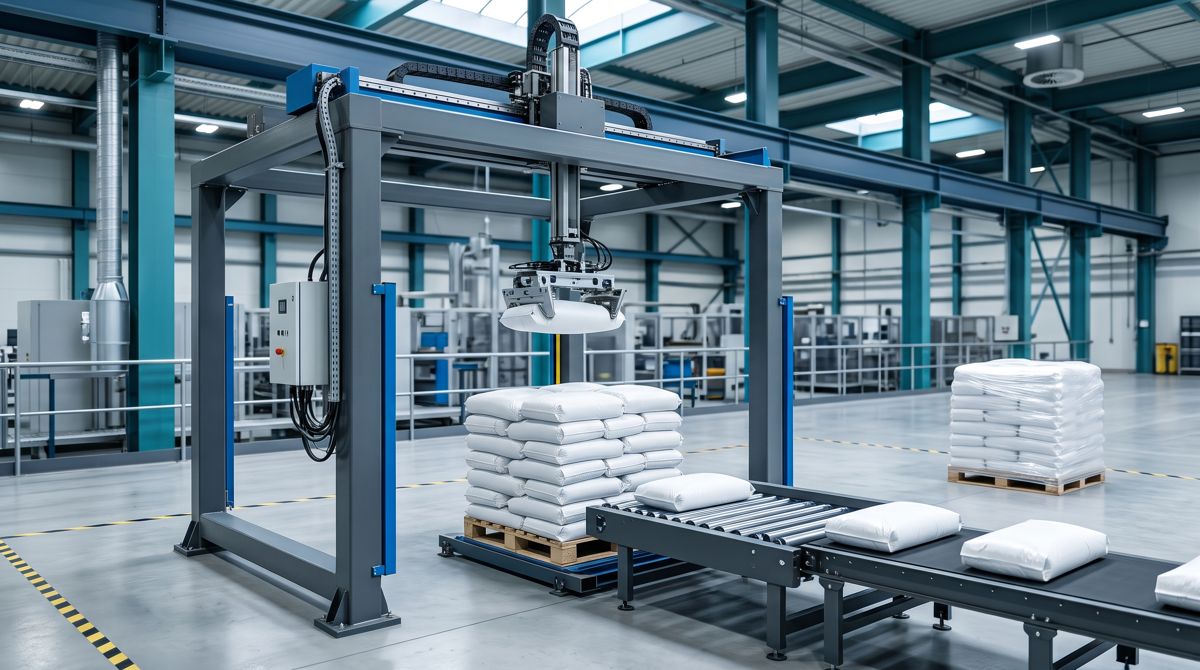
Cartesian gantry palletizer with a gripper stacking bags in neat layers on a pallet
Bag palletizer

Heavy bags and cartesian gantries

For 25 or 50 kg bags the choice is between an articulated robot and a cartesian gantry. The bag arrives on the conveyor, passes through a roller or press that flattens it and spreads the contents, and is picked by a gripper that supports it from below. A well-built pallet of bags travels better, and the stretch wrapper downstream adds stability with film.

  • Fork or finger gripper that supports the bag without stress points.
  • Bag flattener and weight check before pickup.
  • Rotary arm or turntable stretch wrapper at the end of the cycle.

Which palletizer does your line need?

Tell us what you palletize, how many cases per minute you produce and how much space you have after the packaging machine. Those three facts are enough to narrow the choice to one or two types and request an quote from the right manufacturers.

  • Cases, bags and bundles
  • Technical support in Italy
Technical criteria

How to choose an automatic palletizer.

Two quotes with the same robot can perform very differently in production, and the difference almost always lies in the points below.

Real peak rate

What counts is the number of cases per minute at peak times plus the time for the pallet change, rather than the shift average. A cell sized on the average stops right when production peaks.

Products and gripper

Weight, size, rigidity and packaging type decide the gripper, which often affects the result more than the robot does. An open-top carton, a soft bundle and a bag each need a different grip.

Pallet patterns

Column or interlocked patterns, allowed overhang, slip sheets and maximum pallet height. Ask to see a simulation of your own patterns before you order.

Formats and changeover

How many products share the same palletizer and how often they change. With many formats you need recipes that are easy to create and sometimes a universal gripper or an automatic tool changer.

Layout and pallet flow

Floor space, building height, position of the stretch wrapper and of the forklift that collects the pallet. The area works well when the full pallet can also leave without getting in the way.

Safety and CE marking

Fencing, light curtains with muting at the pallet exit or laser scanners, with safety functions designed to ISO 13849-1. The robot follows ISO 10218 and the complete machine follows EN 415-4, the standard for palletizers and depalletizers.

If your output is low and space is tight, also see the page on collaborative robots for end of line. To move finished pallets to the warehouse without forklift drivers, see the industrial automation and material handling page, and the other categories are listed in DIPITECH solutions.

Project and purchase

Who designs it, who installs it and what you need to get started.

A palletizer is a line project more than a catalog product. The manufacturer or integrator who builds it carries out the site survey, designs the cell around your products, installs it, commissions it and issues the CE declaration for the complete machine. Our role is to help you define the request clearly, compare quotes and coordinate the technical discussion with the manufacturer, so that every quote describes the same thing.

Before choosing between new and used, keep in mind that a used palletizer almost always has to be adapted to your formats, with a new gripper, patterns and guarding, and that conformity has to be reassessed when the machine is modified or moved into a new plant. From January 20, 2027, new machinery falls under Regulation (EU) 2023/1230, which replaces Machinery Directive 2006/42/EC, and it is worth discussing this with the manufacturer at the quoting stage.

The DIPITECH approach

The cell is designed around product and line rate.

We start with what comes off your packaging machine and how fast. Two lines that look similar on paper can end up with cells that have little in common.

What to send us for an assessment

  • Products to palletize with dimensions, weight and packaging type.
  • Throughput in cases per minute, average and peak.
  • Number of lines and formats, with how often they change.
  • Pallet type and maximum load height.
  • Layout of the area with available space and clear height.
  • Photos of the packaging area and of your current pallet pattern.
FAQ

Palletizer FAQ

How much does an automatic palletizer cost?

It depends mostly on the type, the throughput, the number of lines served and the gripper. Conveyors, pallet dispenser, slip sheet inserter, guarding and pattern software also add to the price. A single slow line served by a cobot costs much less than a robot cell serving several lines or a layer palletizer. Send us your products, throughput and layout and we will prepare a quote, based on proposals from suitable manufacturers.

What is the difference between a robotic palletizer and a cartesian palletizer?

An articulated robot works from a fixed base with a rotating arm, takes little floor space and easily serves two lines and two pallets. A cartesian gantry moves the gripper along linear axes above the work area, handles heavy loads well and can cover many pallet stations side by side, but it is taller and less agile when the layout changes.

When does a cobot palletizer make sense?

When output is low, cases are light and space is limited. It handles a few cases per minute and moderate weights, but it fits in a compact area, often with reduced guarding if the risk assessment allows it. For higher rates or weights you need an industrial robot in a guarded cell.

How are bags palletized?

The bag is first flattened so the contents spread out and the layer stays level, then it is picked with a fork or finger gripper that supports it from below. Articulated robots or cartesian gantries are used, and an interlocked layer pattern together with stretch wrapping keeps the pallet stable in transit.

Which safety standards apply to a palletizer?

The complete machine must comply with Machinery Directive 2006/42/EC, replaced from January 20, 2027 by Regulation (EU) 2023/1230, with a risk assessment to ISO 12100. Palletizers have their own standard, EN 415-4, the robot follows ISO 10218 and safety functions follow ISO 13849-1. Fencing, light curtains and scanners are sized on these references.

Can a palletizer handle several formats and lines?

Yes, and it is one of the reasons to choose a robot. Each format has its own recipe with gripper, pattern and pallet height, and one robot can serve two or three lines if the total rate allows it. With many different formats, consider a universal gripper or an automatic tool changer.

How do I request a quote?

Message us on WhatsApp, by email or through the form with your products, weights, throughput, number of lines, pallet type and available space, ideally with a layout and a few photos. We reply within 24 hours, suggest the right type and collect manufacturer proposals for your quote.

Application support

Support with your choice, before and after you buy.

We help you choose a palletizer for your end of line, and you have technical support in Italy in the discussion with the manufacturer, including after startup.

Contact

Let’s find the right palletizer for your line.

Whether you ship light cases or 50 kg bags, the starting point is your product and your line rate, and from there we build the request for manufacturers.

Application request

Tell us what you need to palletize.

Describe your products, line rate and available space; add a layout or photos of the end of line if you have them.

WhatsApp