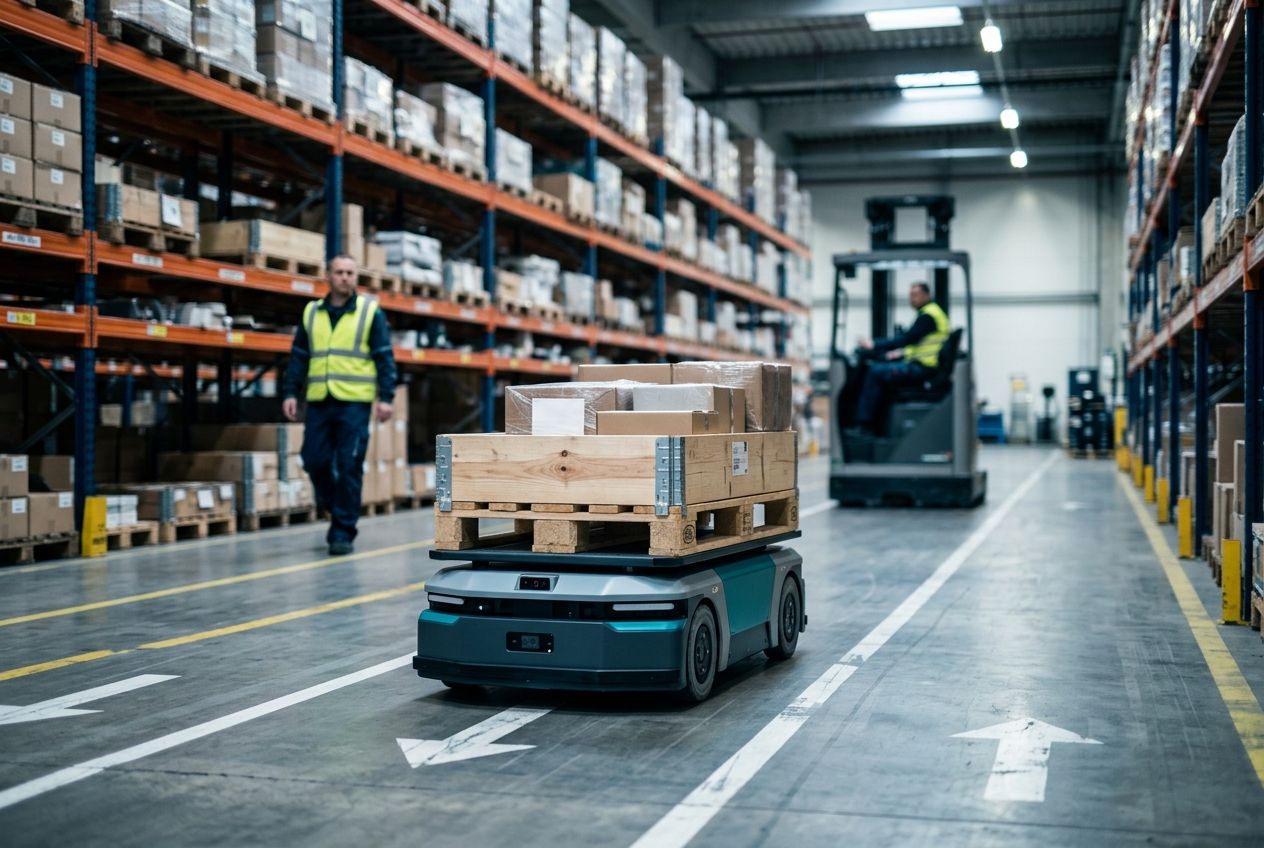
Getting a robot to drive between the racks is, today, the easy part. Anyone automating pallet movement in a warehouse that is already working runs into the other half of the problem: getting that vehicle into a building designed for people and forklifts, and doing it without switching off production on the day it goes live. Projects in existing buildings almost always trip on the surroundings rather than the vehicle. They trip on the floor that isn't as flat as it looks, the aisle too narrow for two, the host system that can't tell a machine where to go. So it pays to turn the usual order around and start from the building and the flows it already has, asking which of those flows is ready to give way first to a machine.
Start with the shuttle nobody wants to run anymore
The first flow to automate is the most boring one on the floor: the shuttle a forklift repeats, identical, dozens of times a shift, always between the same two points. Dock to storage, end of line to warehouse, the back-and-forth between two distant bays. These routes are fixed, predictable and medium-to-long, and that's exactly why an AMR absorbs them well. A 120-meter shuttle run forty times a shift, there and back, adds up to almost 10 kilometers of driving per shift that adds nothing to the product, only an operator's hours and a truck's wear. On two shifts those numbers double, and that is where material handling stops being a detail and becomes a cost line with a name.
The rule for choosing is a combination of three conditions more than volume itself: fixed endpoints, high frequency and a distance worth the trip. Where even one of the three is missing, automation loses ground. Non-standard picking, the occasional load, the oversized part that changes destination every time stay more efficient with an operator and a forklift. Putting them at the top of the list is the fastest way to make a project that would have paid off elsewhere look disappointing. The link between the building and an outdoor yard on asphalt is a case of its own. It is often repetitive and attractive, but crossing the threshold between inside and out adds ramp gradients, a different surface under the wheels and a jump in light that localization has to handle. It is better left to a second phase, once the fleet has proved itself on indoor flows.
People, forklifts and AMRs in the same aisle
An AMR is built to give way. It detects a person or an obstacle and slows, stops, waits. That's what makes it safe, and it's also what caps its output in an aisle used by manned forklifts in a hurry. The safety side is governed by ISO 3691-4:2023 for driverless industrial trucks, which requires the system to detect people across the full width of the vehicle and in the direction of travel, with safety-rated reduced speed and protective stops. The Performance Level demanded of each safety function, from ISO 13849-1:2023, follows from the site risk assessment and should be required in writing.
What the standard doesn't settle, and what actually settles real throughput, is how the flows cross. There is no middle road. Either the routes are separated, with dedicated aisles, time windows, floor marking and right-of-way rules written down before anyone improvises them. Or every meeting with a manned forklift slows the AMR, and the cycles-per-hour figure on the datasheet never shows up on the floor. A busy two-way corridor is the worst place to debut a fleet. The same flow, moved onto an aisle the vehicles don't have to contest with anyone, changes the numbers entirely. Preparing the operating zones is an explicit part of ISO 3691-4:2023, which devotes a normative annex to it. Italian INAIL data on forklift accidents, where the most frequent pattern is a worker on foot being struck, show why separating routes pays off even before the robots arrive. The topic is developed in our article on AMRs and injury reduction.
Which of your pallet flows is ready first?
Send us your floor plan, the flows between docks, storage and lines, your shifts and pallet types, and we will identify the shuttle to start from without stopping the warehouse. An assessment of your layout and flows, with a tailored quote within 24 hours.
Email us Message us on WhatsAppWhat the building asks for before the quote
Before comparing models it pays to know whether the building is ready, because much of the cost and delay in a project inside an existing building comes from the surroundings. These are walk-through checks, done with a tape measure and a critical eye, and they change the quote more than any datasheet. The floor comes first, because flatness and the state of the joints affect vehicle localization and the stability of a raised load, and the tolerances manufacturers state have to be checked on the real floor, not the one in the rendering. Cracks, steps and wide joints need fixing before the vehicles arrive.
Aisles are the second point. Usable width is the sum of the vehicle, the load and the lateral safety margins, and for two-way traffic it doubles, with a central clearance. That is why an aisle that works for a forklift may not work for an AMR that has to keep its own safety distances. Charging stations have to sit where they don't get in the way and where there is electrical power to feed them. Opportunity charging, in short bursts during the natural pauses of the cycle, has to be planned into the layout from the start, as our piece on sizing AMR charging stations explains. Last comes the network, because continuous communication between vehicles and fleet control needs coverage without gaps along the routes, and signage and operating zones should be designed together with safety.
None of these points is exotic, which is exactly why they get taken for granted. It is the reason a technically sound automation project sometimes delivers half of what was expected: the vehicle does its job, and the building works against it.
The vehicle knows how to move, the WMS decides where
An AMR left to itself knows how to get from one point to another, and nothing more. Missions (which pallet, from where, to where, when) are generated by the host system. Without a link to the WMS or ERP you get a machine that drives beautifully and that someone has to command by hand. In practice it is a truck dispatched by voice rather than an automated flow. Real integration lives in details you don't see in a demo: who tells the fleet that a pallet is ready at the end of the line, how the vehicle confirms delivery to the system, what happens when the destination is occupied.
Above the individual vehicles sits fleet orchestration, which assigns missions, manages traffic, sets priorities and sends vehicles to charge without stopping the service. This is where interoperability comes in, a choice that weighs over the long run. The VDA 5050 interface, which reached version 3.0.0, published by VDA and VDMA in March 2026, defines uniformly how a central control sends transport orders to vehicles and how vehicles report status and position. It uses MQTT messages in JSON format and describes routes as nodes and edges that each vehicle interprets with its own navigation. Adopting it makes it possible to coordinate vehicles from different makers in a single fleet and to expand it over time without being tied to one supplier. The specification describes itself as optional and non-binding. If it isn't written into the order and the specification, you don't get it, and you notice the lock-in the day you need a second supplier.
How many vehicles: the number is set on the worst hour
The number of vehicles comes from a simple ratio, the missions required in an hour divided by those one vehicle completes in the same time after charging, traffic and waits at intersections. What betrays it is the data that goes in, because a fleet sized on an ordinary week passes acceptance and then gives way on the day that matters. The full method, with a worked two-shift example and how to collect movement history, is in our article on evaluating an autonomous forklift and AMR project. For a start in a running warehouse, one practical consequence is enough. With an interoperable fleet the busy season is handled by adding vehicles, rented if need be, rather than redoing the project. The specification should say so as clearly as any technical requirement.
Who signs off on a mixed-brand fleet
Ultrasonic or radiographic testing has a neat pair of standards, one saying how to carry out the test and another saying when the result is accepted. For AMRs that pair is missing on the performance side. There is a solid safety standard, ISO 3691-4:2023, but the performance acceptance criterion (how many pallets per shift, with what punctuality, under what conditions) is written by the buyer and verified with a field acceptance test. Knowing that changes how you approach the performance specification, which is a document to produce in-house before the tender.
On safety, by contrast, responsibility needs careful tracking when the fleet is mixed. Each vehicle carries its own conformity and its own marking. Today the reference is the Machinery Directive 2006/42/EC, for which EN ISO 3691-4:2023 is harmonized by Implementing Decision (EU) 2024/1329, and from January 20, 2027 it gives way to Regulation (EU) 2023/1230. A set of vehicles from different makers, coordinated by fleet control and integrated with the plant, can however amount to an assembly of machinery. At that point someone has to take on the conformity of the system as well as that of each vehicle. VDA 5050 settles how the vehicles talk and stops there. Its own text excludes safety and the allocation of responsibilities among operator, integrator, vehicle makers and fleet control provider. Who declares the conformity of the whole, and who checks it, is the question to put on the table before signing.
Written down, the part of the specification that holds all this together looks something like this line:
Dock→storage flow: 480 missions/shift in the busiest recorded shift, 2 shifts; vehicles compliant with EN ISO 3691-4:2023, Performance Level of safety functions per ISO 13849-1:2023 and the site risk assessment; person detection across the full width and in the direction of travel; fleet orchestration via the VDA 5050 3.0.0 interface; WMS integration with mission generation and confirmation; acceptance test in the busiest recorded week, not on the annual average; conformity of the whole system and the party declaring it defined in the contract.
Handing a supplier a line like that means asking for a quote on a whole flow, and it is the kind of request only a well-prepared counterpart can answer. The available technologies are described on the pages about autonomous robotic forklifts for pallet handling and industrial automation and material handling robotics. If the choice between guided vehicle and autonomous robot is still open, the comparison is in our article on AGVs and AMRs.
What to send us for an assessment
The place to start is a single fixed, repetitive flow, chosen after the walk-through and measured before the quote. To find it we need the following:
- a dimensioned floor plan with docks, storage, lines, aisles, doors and ramps;
- pallet flows between pairs of points, with missions per shift and per hour;
- number of shifts and the busy periods of the year;
- pallet and load type: dimensions, weights, pick-up and drop-off heights;
- manned forklift and pedestrian traffic along the candidate routes;
- floor condition, network coverage and power available for charging;
- the WMS or ERP in use and how missions are assigned today.
You can send them by email to info@dipitech.com or on WhatsApp, with the floor plan and a few photos of the aisles.
Frequently asked questions about automating pallets with AMRs in a running warehouse
Which pallet flow should be automated first in a running warehouse?
An indoor shuttle between two fixed points, for example dock and storage or end of line and warehouse, that keeps a forklift driver busy for much of the shift. The link to the outdoor yard comes later, because ramps, asphalt and changing light call for extra checks on the vehicle and its localization.
How do AMRs, forklifts and people share the same aisle?
With rules written before start-up: dedicated aisles or time windows, right-of-way at intersections, reduced speeds where clearances are missing. Without them the robot stays safe but slows at every encounter, and the throughput measured on the floor drifts away from what was promised.
What should be checked in the building before asking for an AMR quote?
It helps to photograph and measure the spots where forklift drivers slow down today: damaged joints, thresholds, blind intersections, aisles that get tight with a pallet on board. They are almost always the same spots where a robot will lose time, and knowing them in advance lets you compare quotes on common ground.
Do AMRs need to be integrated with the WMS or host system?
Yes, if the goal is an automated flow rather than a vehicle commanded by hand. The host system has to generate missions and receive delivery confirmations; VDA 5050, in version 3.0.0 from March 2026, standardizes the dialogue between fleet control and vehicles, while the interface to the WMS remains project work to budget for.
Who is responsible for the safety of a fleet with vehicles from different makers?
Each maker answers for its own vehicle, but the coordinated whole can amount to an assembly of machinery with its own conformity. The VDA 5050 specification does not assign that responsibility, so it has to be allocated by contract, also stating whether the declaration will follow the Machinery Directive or Regulation (EU) 2023/1230, which applies from January 20, 2027.