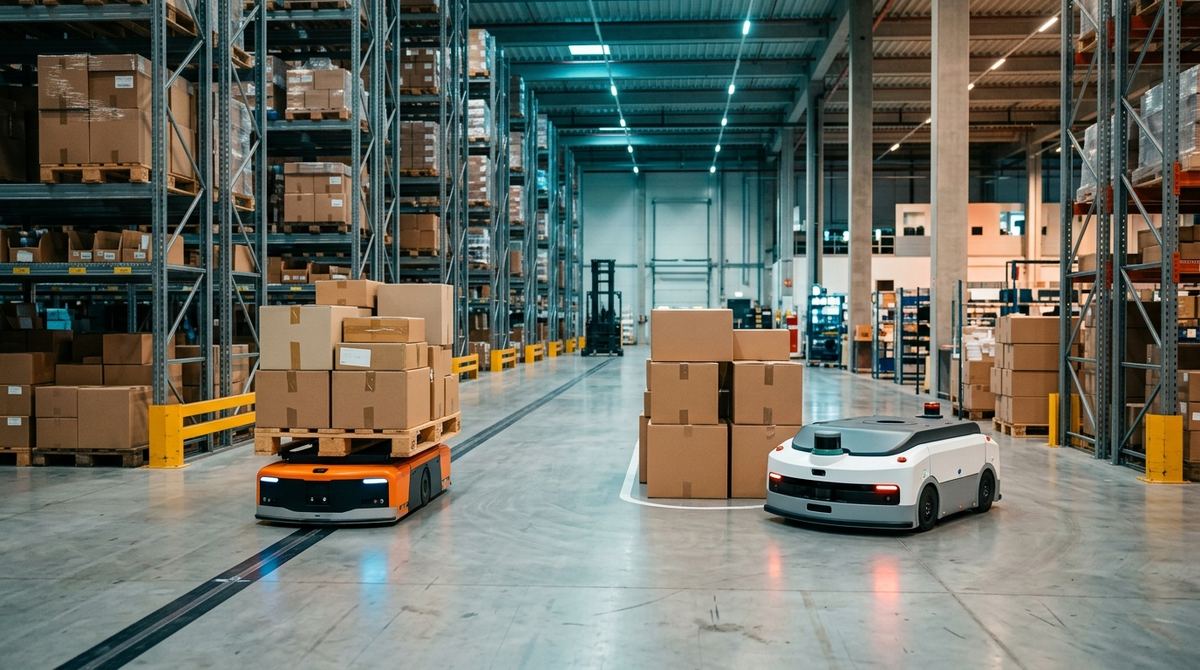
Two vehicles can run the same aisle, on the same job, and end up costing very different amounts over ten years. The reason is how they find their way. One reads the building and the other follows a line laid into the floor. That single difference decides what gets cut into the concrete, how many days the plant stands still to install it, and what happens the next time the flow changes. Pick wrong in one direction and a company pays for guidance infrastructure it never needed. Pick wrong in the other and it runs a fixed path through a warehouse that gets reshuffled every season.
How an AGV finds its way, and how an AMR does
An AGV (automated guided vehicle) follows a predetermined path defined by guidance infrastructure. The technologies came one after another: a wire buried in the floor, magnetic tape or spots, floor QR codes, and laser guidance that triangulates on wall-mounted reflectors, typical of the so-called LGVs. The vehicle knows where it is relative to the path, not relative to the building. When something blocks the route it stops safely and waits for someone to clear it. Vis's survey in the European Journal of Operational Research (2006) captures the logic well: designing an AGV system starts with designing its path network, and everything else follows from that.
An AMR (autonomous mobile robot) builds and updates a map of its surroundings with SLAM (simultaneous localization and mapping), usually with lidar or cameras, and localizes on the building's natural features such as walls, racks and columns. No route is wired anywhere. The robot plans one for each mission and recalculates it on the move, slowing down and steering around people and obstacles. In their 2021 review in the same journal, Fragapane, de Koster, Sgarbossa and Strandhagen identify this decision-making autonomy as what sets AMRs apart from AGVs, and as the source of a new set of fleet planning and control problems.
The acronyms don't settle the question anymore, either. Plenty of recent vehicles navigate on natural features but stay on constrained virtual paths, and what one supplier sells as an AMR another calls an AGV. What holds up in a comparison is the set of questions in the table further down: infrastructure, how often the layout changes, mixed traffic, takt time. And how honestly a given machine answers them.
The differences that move the project
| Aspect | AGV | AMR |
|---|---|---|
| Required infrastructure | Wires, magnetic tape, tags or reflectors to install and maintain | No physical guidance; needs a map, wireless coverage and charging points |
| Layout changes | Physical change to the path, with work and downtime | New map and new routes in software |
| Installation time | Weeks or months, with building work | Days or weeks, without significant work |
| Fleet growth | Limited by the capacity of the wired path | Vehicles added and coordinated by the fleet manager |
| Obstacles and people | Protective stop and wait | Slow down, steer around, re-plan |
| WMS and ERP integration | Project-specific, often proprietary | APIs and standard interfaces such as VDA 5050 |
| Maintenance | Simple vehicle plus upkeep of the guidance | More complex vehicle (sensors, computing), no guidance to maintain |
| Cycle predictability | Highest: fixed paths and times | High, but it varies with traffic in the area |
The last row matters most on synchronized lines. Re-planning is an advantage in variable flows, yet it adds variability to cycle times. When a line is fed at a fixed takt, the absolute predictability of an AGV can be worth more than all the flexibility of an autonomous robot.
Fixed flows or variable ones: where do you stand?
Send us missions per hour, distances, loads and layout, and we will tell you whether an AGV, an AMR or a mixed fleet fits. An assessment of your layout and flows, with a tailored quote within 24 hours.
Email us Message us on WhatsAppSafety: same standard, different behavior
On the regulatory side, industrial AGVs and AMRs both fall under ISO 3691-4:2023, the standard for driverless industrial trucks and their systems: person detection, safety laser scanner protective fields, speed control, protective stops and the preparation of operating zones. When the topic is CE marking, the version that counts is the harmonized EN ISO 3691-4:2023, cited in the Official Journal by Implementing Decision (EU) 2024/1329, which gives presumption of conformity with the Machinery Directive 2006/42/EC. Risk assessment under ISO 12100:2010 sits upstream. From January 20, 2027 the Directive gives way to Regulation (EU) 2023/1230, which for the first time deals explicitly with autonomous mobile machinery. In the United States the references are ANSI/ITSDF B56.5-2024 for guided vehicles and the ANSI/A3 R15.08 series for industrial mobile robots.
So safety doesn't depend on the acronym. It depends on vehicle compliance, on the quality of the integration and on the risk assessment of the real site, with its intersections, doors, shared areas and overhanging loads. The behavioral difference still matters for throughput in busy areas: where an AGV stops and waits, an AMR slows down and drives around. How much that changes injury figures is covered in our piece on AMRs and warehouse injury reduction.
When the AGV is still the right call
The AGV earns its place where flexibility isn't needed. A handful of A-to-B routes repeated thousands of times, in an area with little mixed traffic, is its natural ground: the protective stop becomes a rare event instead of a bottleneck, and the simple vehicle pays off. The same goes for heavy or oversized loads such as reels and coils, where heavy-duty AGVs and LGVs have decades of installations behind them, and for feeding lines at a fixed takt, where cycle-time predictability is the first requirement. A new building designed around flows that will stay put for years can also amortize guidance infrastructure without strain.
When the autonomous mobile robot wins
The picture flips as soon as the flow changes often. Mission mixes, seasonal peaks, e-commerce orders: re-planning is the AMR's structural advantage here. In existing buildings, laying wire or reflector fields is often impractical, and a robot that navigates on natural features goes in without building work. In busy areas, where people and manned trucks cross the routes all day, stopping at every interference would wreck throughput. And a company that wants to grow in steps can start with a few vehicles on one flow and add robots, not infrastructure. For pallet handling in a warehouse that is already running, the starting path is described in our article on automating pallet moves with AMRs without stopping operations.
Where the cost sits
The useful economic comparison is about where the spending concentrates rather than which vehicle is cheaper. With an AGV the cost shifts to infrastructure and project engineering: route studies, installation work, commissioning. The hidden cost is the cost of change, because every layout change reopens the job. With an AMR the cost concentrates in on-board intelligence (sensors, computing, navigation software) and in fleet software, often licensed or sold by subscription, while infrastructure is minimal and change is cheap. Payback profiles end up very different depending on the flows, and the method for working them out, with recurring costs and stated assumptions, is in our analysis of AMR ROI, TCO and payback.
One simple question helps settle it. If the routes two years from now will be the same as today, an AGV is defensible. If nobody in the company can answer that with confidence, the AMR's flexibility already works as room to maneuver.
Decision table
| If your plant has... | Lean toward |
|---|---|
| Few fixed routes, very high repetition, stable volumes | AGV |
| Variable flows, seasonal peaks, mission mixes | AMR |
| An existing building, no work possible on the floors | AMR |
| Very heavy or non-standard loads on dedicated routes | AGV (heavy-duty LGV) |
| Areas shared with people and moving vehicles | AMR |
| Line feeding at a fixed, synchronized takt | AGV |
| Phased growth, incremental budget | AMR |
| A layout reconfigured several times a year | AMR |
| Fixed backbones plus variable distribution | Mixed AGV and AMR fleet, with a fleet manager and a VDA 5050 interface |
The last row needs a caveat. The VDA 5050 specification, which reached version 3.0.0 in March 2026, standardizes communication between fleet control and vehicles from different makers, but it states that it covers neither safety nor traffic management logic. Who signs off on the conformity of a mixed fleet has to be settled in the contract. To put numbers behind the table, the feasibility study method is in our article on evaluating an autonomous forklift and AMR project.
What to send us for an assessment
To tell you whether your flow calls for an AGV, an AMR or a mixed fleet, a few figures are enough, as long as they are measured rather than estimated:
- missions per hour, with the worst hour kept apart from the average;
- origins and destinations, with the distances of the main routes;
- load type: pallets, bins, roll cages or totes, with weights and dimensions;
- a dimensioned floor plan with aisle widths, doors, ramps and intersections;
- mixed traffic: people and manned trucks sharing the routes;
- how often the layout has changed over the last two or three years;
- systems to integrate: WMS, ERP or MES, and any lines to be fed.
You can send them by email to info@dipitech.com or on WhatsApp, with the floor plan and photos of the critical spots. The technologies DIPITECH represents in Italy are described on the pages about robotic forklifts and AMRs for pallet handling and the goods-to-person automated warehouse, part of our industrial automation and material handling robotics offering.
Frequently asked questions about AGVs and AMRs
What is the difference between an AGV and an AMR in one sentence?
An AGV follows a path defined by guidance infrastructure and stops when something is in the way. An AMR localizes on the building's natural features and recalculates its own route. For a specification, though, what counts is the stated behavior, because several recent vehicles mix the two logics.
Is an AMR safe around people?
It is when both vehicle and site comply: for CE marking the reference is EN ISO 3691-4:2023, harmonized by Decision (EU) 2024/1329, which among other things requires operating zones to be prepared. In Italy, INAIL data show that in fatal forklift accidents the most frequent pattern is a worker on foot being struck, which is exactly where person detection and route separation carry the weight.
Does the warehouse need changes before AMRs go in?
Guidance installation work is usually avoided, while some boundary conditions still have to be checked: floors in good shape, aisles wide enough for the loaded vehicle and its clearances, wireless coverage without gaps, and electrical power where the charging stations will go. These are site-survey checks to run before the quote.
AGV or AMR for an existing warehouse?
In an existing building the AMR starts ahead because it needs no guidance laid and coexists with the vehicles already there. The AGV comes back into play when routes are few, fixed and dedicated, with heavy loads and little mixed traffic, or when a line needs synchronized cycle times.
Can AGVs and AMRs work in the same fleet?
Yes, and coordination runs through the fleet manager. VDA 5050 version 3.0.0, released in March 2026, standardizes how orders and states are exchanged between central control and vehicles from different makers. It does not assign responsibility for the safety of the whole system, which has to be written into the contract.