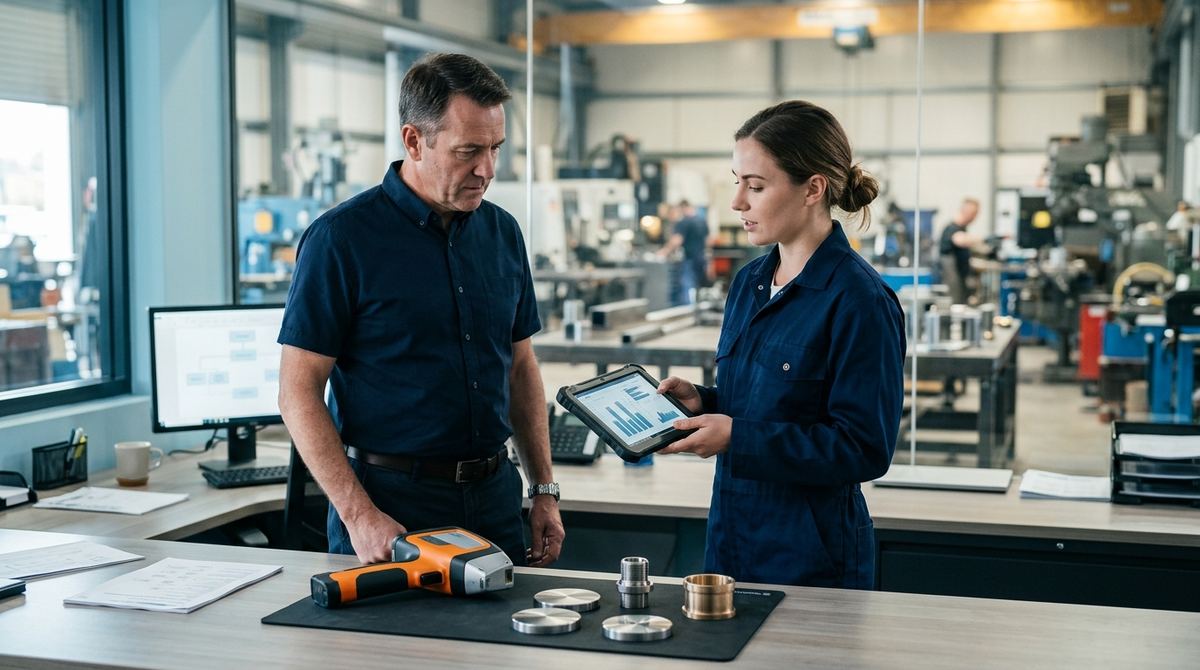
Anyone who asks for a quote on a handheld XRF analyzer soon finds out there is no real price list. Two instruments that look identical can be worth very different amounts, because the detector, the X-ray tube, the calibrations and the software inside them differ. Above all, the job they will do differs: PMI at incoming inspection, scrap sorting in the yard, assaying precious metals and quality control each call for a different configuration, at a different cost. Before talking price, then, it pays to work out which configuration the application really needs, and what every day without it costs. The rest is an investment decision like any other: purchase, rental or an outside lab, with the numbers in hand.
Why an XRF spectrometer's price isn't on a price list
A handheld XRF spectrometer measures the X-ray fluorescence a sample re-emits when the tube excites it; each element answers at its own energy, and the software turns the spectrum into a composition or an alloy name. The principle is the same for every instrument, and choosing the right one for your alloys and environment is covered in the guide to choosing a portable XRF analyzer. The cost, though, is made in the details, and the same model name can hide configurations that are far apart. Two offers can therefore only be compared line by line: detector, tube, calibration modes, libraries, ruggedness, accessories, calibration checks and service. A cheaper offer that leaves out two of those lines usually makes you pay for them later.
SDD or Si-PIN detector, the line that moves the price most
The detector is the component that weighs most on the cost, and for a physical reason. A Si-PIN photodiode counts photons with limited energy resolution and saturates early, which is fine for separating very different alloys, with longer measurement times. A silicon drift detector (SDD) collects charge on a very small anode, and therefore at very low capacitance, so it handles much higher count rates without broadening the peaks. As early as 1998, Lothar Strüder's group reported in the Journal of Synchrotron Radiation resolutions of about 140 eV at 6 keV with Peltier cooling alone, at 253 K. The same detectors handled count rates up to two million photons per square centimeter per second. Lechner and colleagues, in Nuclear Instruments and Methods A in 2001, described detectors of this type working at high count rates at room temperature.
In the field, the difference shows up in seconds. Method 6200 of the US Environmental Protection Agency (EPA) notes that the precision and detection limits of a field portable instrument depend on count time as well as on the matrix. For the same result, a detector that counts faster finishes sooner, and over a shift of hundreds of readings the time saved is worth more than the difference in purchase price. Within the SDD family, active area and effective resolution matter too. Light elements such as magnesium, aluminum and silicon add another line, because their photons get lost in air. They need a short optical path and, at low concentrations, helium purge or vacuum, with accessories and consumables that belong in the quote. Carbon stays out of reach for any XRF, and when the specification calls for it the cost line becomes a different technique, as the comparison of LIBS and XRF for carbon shows.
Tube, anode and filters: what the instrument has to excite
The X-ray tube decides which elements are excited efficiently. The anode material (rhodium, silver, gold or tungsten) and the maximum voltage are chosen around the application's critical elements. Exciting an element's K lines takes a voltage above its absorption edge, which rises with atomic weight. Switchable primary filters optimize excitation for different groups of elements within the same measurement. A more powerful tube and a richer filter set raise both performance and price. For common alloys at incoming inspection they are often unnecessary; for precious metals and trace elements they make the difference.
Calibrations, grade libraries and software: who decides what gets accepted
An instrument earns its keep on the shop floor by turning a spectrum into a decision, and that takes different calibration modes for different questions: alloys, precious metals, soils, ores, and materials restricted under RoHS. Each one is a module, often sold separately, and a quote that doesn't list them is incomplete. On rocks and soils, for example, alloy mode produces meaningless numbers, as the article on portable XRF for mining and geology explains.
In alloy mode the instrument compares the measured composition against a library of tabulated grades (AISI, UNS, EN) and reports the closest match above a threshold somebody has set. The identification and sorting method is described in ASTM E1476-04, reapproved in 2022, which is precisely a guide: the acceptance criterion is written in the specification, and its last step ends up in that software field. Library breadth, the ability to add your own grades and control over the threshold are real price lines, because they decide how many parts pass without argument. The same goes for reporting, meaning stored readings with photos and notes and export to ERP and quality systems. API RP 578, in its fourth edition of February 2023, recommends that plant owners keep a written material verification program with documented results. For anyone working on pressure equipment, then, the software's documentation side weighs as much as the measurement, a case developed in the article on PMI verification of oil and gas piping and welds.
Ruggedness and accessories: the yard costs more than the lab
IP rating against dust and moisture, protection of the measurement window, operating temperature range and drop resistance matter little on a bench and a great deal in a scrap yard, where the instrument works the whole shift. The criteria for that job are in the article on XRF scrap alloy sorting and recovery value. Accessories are small lines that add up: a benchtop stand that turns the handheld into a lab station, hot-swappable spare batteries, spare windows, a carrying case, certified check samples. For precious metals a closed stand is close to mandatory, because small items and repeated measurements need a stable geometry, as discussed in the article on XRF analysis of gold and precious metals.
Minimum or full configuration: it depends on the application
| Application | Typical configuration | What increases the investment |
|---|---|---|
| Basic PMI at incoming inspection | Standard SDD, industrial alloy library, essential reporting | Trace-element sensitivity, integration with the quality system |
| Scrap sorting in the yard | Fast SDD, reinforced mechanics, full-shift batteries | IP rating, window protection, data management to certify lots |
| Precious metals and karat | Dedicated Au/Ag/Pt/Pd calibration, measuring stand | Detector resolution, plating handling, end-customer reports |
| Laboratory quality control | High-resolution SDD, benchtop stand, full software suite | Detection limits, multiple calibrations, full traceability |
If your work is basic PMI at incoming inspection on common alloys, a standard SDD with an industrial library and essential reporting covers the need. Spending more on traces or filters wouldn't improve your decisions. If the measurement ends up in a commercial dispute, in a certificate to your customer or in light-element control, the full configuration pays for itself because it cuts the doubtful cases. Between minimum and full lies the difference between paying for performance you need and paying for some you will never use.
Which XRF configuration does your application need?
Tell us your alloys or materials, critical elements, volumes and working environment: we'll propose a reasoned configuration and a tailored quote within 24 hours, with a test on your own material.
Email us Message us on WhatsAppCalibration checks, service and a loaner unit: the costs that come after purchase
The purchase price is only the first line of the cost. The instrument has to be checked periodically against certified reference materials, and a reference material is only as good as its producer. ISO 17034:2016 sets the competence requirements for producers, and it is the first thing to look for on the certificate. When a legally defensible confirmation is needed, it comes from a laboratory accredited to ISO/IEC 17025:2017, the standard on the competence of testing and calibration laboratories. Then there are consumables such as protective windows and batteries, library and software updates, and the warranty.
The most underestimated line is downtime. An instrument sent abroad for weeks of repair puts the department back to deciding by eye, and during those weeks the cost per verified part goes up. When comparing offers, then, technical service in Italy, response times written into the contract and a loaner unit during repairs all count. DIPITECH includes them in its proposal, and they are worth asking any supplier to put in writing.
In Italy, using an instrument with an X-ray tube is a practice governed by Legislative Decree 101/2020, which transposes Directive 2013/59/Euratom. Outside the exemptions of Article 47, Article 46 requires it to be notified at least thirty days before it starts. The process then involves a radiation protection expert and operator training. For NDT personnel, qualification follows ISO 9712:2021, whose list of methods does not include PMI by XRF. API RP 578 still recommends written procedures and trained operators, and a serious quote states who trains your staff at delivery.
Purchase, rental or an outside lab: the cost per verified part
Many buyers compare the investment against zero, as if the alternative were free. Not verifying materials, or verifying them outside, has precise costs that are simply less visible. The cleanest way to compare them is a single figure, the cost per verified part. For each option, add up the annual cost (instrument or rental fee, calibration checks, service, labor hours) and divide it by the parts that option actually verifies in a year. Measurement time, preparation and repeat readings after false alarms belong in the count too.
An outside laboratory has an obvious cost per sample and a hidden one, the wait. An example built on our own assumptions: 20 samples a month, with an average wait of 5-7 working days for the report. You pay for 240 analyses a year and pile up weeks of material held at incoming inspection, waiting for a figure a handheld spectrometer delivers in seconds. With recurring volumes, the accredited laboratory remains indispensable for legally defensible confirmations, but as a screening tool it becomes the most expensive option.
Rental works for one-off needs such as a plant turnaround, a PMI campaign, an audit or a seasonal peak at incoming inspection, with costs charged to the single job and no capital tied up. Once use becomes recurring, rental fees add up and the math shifts toward purchase. Owning also brings an advantage that is hard to budget: the check gets done because the instrument is there, without waiting for someone to arrange a rental. The break-even point depends on two numbers you already have, days of use per year and the rental fee you're offered, and it pays to ask for both options in the same offer.
The heaviest line is also the rarest, a nonconformance event. A material mix-up that reaches production or the customer triggers 100% re-sorting of stock, rework, returns, penalties and, in regulated industries, formal investigations. Identifying and separating mixed lots of metals has a guide of its own, ASTM E1916-24. Estimating the historical frequency of such events, even one every few years, and the full cost of a single one gives a benchmark that often settles the question on its own. The scrap and semi-finished trade has an everyday version, because a grade dispute without documented measurements ends in a discount. The average discount multiplied by the disputed lots in a year is a number the sales office knows well.
What to send us for an assessment
To propose a reasoned configuration, and an offer you can compare with others, a few precise details are enough:
- alloy or material families to verify and the elements that decide compliance, noting whether carbon is needed;
- expected concentrations, especially for light elements and traces;
- number of analyses per day or month and how urgent the result is;
- working environment: laboratory, workshop, yard or site;
- documents you must produce: PMI report, certificate to the customer, traceability in your ERP;
- radiation protection status: first X-ray device in the company or a practice already notified;
- expected days of use per year, to compare purchase and rental.
You can send them by email to info@dipitech.com or on WhatsApp, attaching photos of the parts or a typical certificate if you can.
In the end there is a single criterion: the right configuration supports the decisions you make every day at the lowest cost per verified part among the real options. Anyone who reaches the quote with these details gets comparable offers, and often discovers that the suitable configuration costs less than the maximum one they would have asked for out of caution. Available solutions are on the page about XRF and PMI analyzers for material analysis, with details of the handheld XRF spectrometers and, for carbon, of the LIBS-based PMI analyzers. The next step is a demonstration on your own material, with a tailored quote within 24 hours.
Request a quote
Leave your name, email, and a few lines about your application, with no obligation. We reply within 24 hours with initial technical guidance and a quote.
Frequently asked questions on handheld XRF analyzer price and cost
How much does a handheld XRF analyzer cost?
A handheld XRF analyzer and a handheld XRF spectrometer are the same instrument, and the cost depends mostly on two lines, the detector and the calibrations included, followed by calibration checks and service. An SDD with alloy, precious-metal and soil modes plus a benchtop stand does not sit in the same offer as a Si-PIN with only the industrial library, even when the housing is identical, which is why DIPITECH doesn't publish price lists and prepares a tailored quote within 24 hours based on your application.
Is an SDD detector worth the price difference over a Si-PIN?
Yes, when you measure aluminum alloys, light elements, traces or high volumes. An SDD counts far more photons with narrower peaks, so it finishes in fewer seconds and separates neighboring lines; over hundreds of readings per shift the time saved outweighs the difference in purchase price. To tell apart a few very different alloys at low volumes, a Si-PIN can be enough.
Is it better to rent or buy an XRF analyzer?
Rental pays for peaks and campaigns, purchase when use is recurring. The break-even point comes from days of use per year and the rental fee offered. Ask for both options in the same offer and compare them on cost per verified part, including the time spent arranging each rental.
What costs come after buying an XRF analyzer?
Periodic checks with certified reference materials, consumables, library and software updates, warranty and service, plus radiation protection compliance. In Italy the practice notification under Legislative Decree 101/2020 must be made at least thirty days before use starts, so it is worth scheduling together with the order. Also ask whether a loaner unit is provided during repairs.
Can an outside lab replace a handheld spectrometer?
Only for very low volumes with no urgency, or as independent confirmation. A laboratory accredited to ISO/IEC 17025 delivers a legally defensible result, but every sample costs shipping and days of waiting, and in daily screening the material sits at incoming inspection. Many companies use the handheld to decide on the spot and the lab only for doubtful cases.