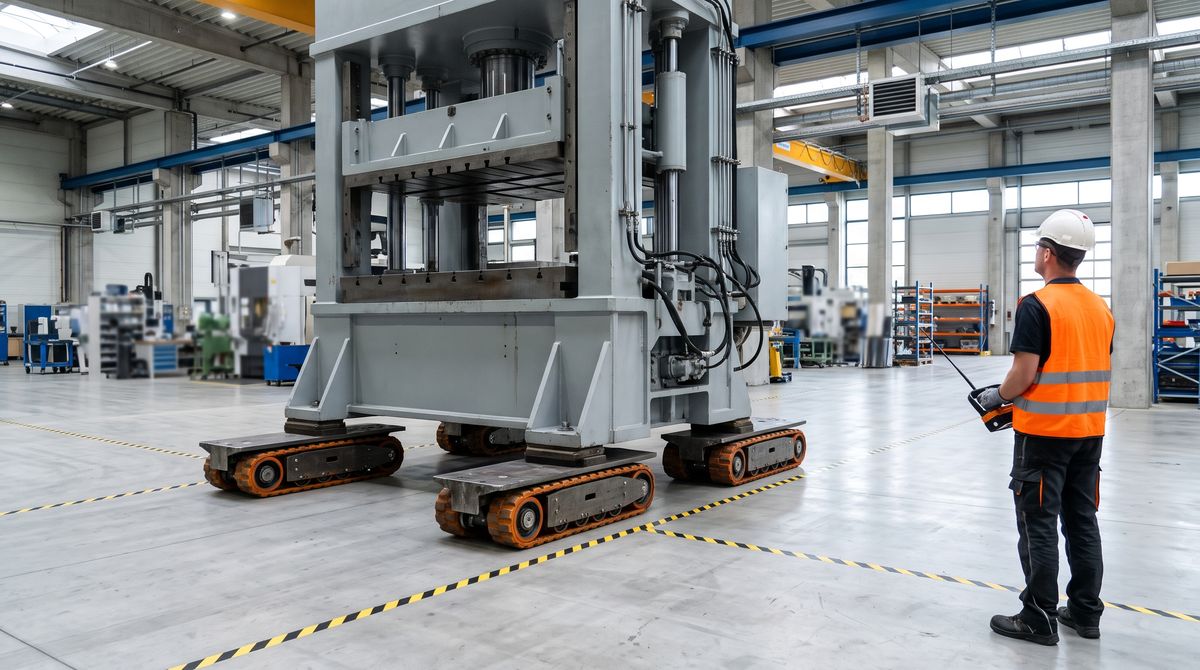
A 28-metric-ton press has to move forty meters, from the back of the building to the new stamping cell. The overhead crane covers only half the route, the largest forklift in the plant is rated for 8 metric tons and the heavy-haul contractor has an opening in three weeks. Meanwhile the new line is waiting. Situations like this are common in plants that rework their layout, change heavy dies or move machines for maintenance, and the most practical answer is often motorized transport skates: wheeled or crawler platforms with electric drive that slide under the machine and carry it at floor level, driven by an operator with a remote control.
The equipment matters, but whether a move goes well is decided earlier, on the numbers for the load, the floor and the route. That is where mistakes are most common, and they are expensive: all it takes is a joint that gives way under a wheel, or a slight slope on which the machine starts moving on its own. The features of the available models are on the page about motorized transport skates for heavy loads, but the calculations come before the choice of model, and they start with the load.
Weight and center of gravity: the figures that set skate capacity
Weight comes from the machine nameplate, the manual or a statement from the manufacturer, and it must be updated with everything added over the years: mounted dies, oil in the power unit, bases, guards. The figure that is almost always missing is the center of gravity, and without it the share of weight on each support point is badly estimated.
Back to the 28 t press, resting on four skates arranged in two rows 2.0 m apart. If the center of gravity were in the middle, each skate would carry 7 t. With the hydraulic power unit and the motor group all on the front side, however, the center of gravity can sit 30 cm forward. The front row then carries (1.0 + 0.3) / 2.0 = 65% of the weight, or 18.2 t, which split over two skates comes to 9.1 t each. Each front skate therefore works 30% harder than the rule-of-thumb estimate would suggest.
There is also a less intuitive effect. A rigid machine on four supports, on a floor that is never perfectly flat, tends to settle on three points, and for part of the route one of the four does little or no work. In the limiting case, with the center of gravity in the middle, the two diagonally opposite skates end up carrying half the weight each.
Heavy rigging therefore often uses a three-point setup, with two skates on one side and a single central support on the opposite side: one steerable skate, or two skates under a spreader beam with a center pivot. With three supports the load split can be calculated without guesswork, and the result is sometimes surprising: on our press, with the two skates under the front side and the single support at the rear, the rear one would carry 35% of the weight, 9.8 t, more than either front skate. The alternative is to size the skates for the worst-case distribution. The margin between calculated load and rated capacity is there to cover these uncertainties, and it should not be used up at the outset.
The floor works as hard as the skate
Each skate rests on a few wheels, and each wheel on a footprint of a few square centimeters. With 9.1 t on an eight-wheel skate, each wheel carries about 1.1 t, roughly 11 kN concentrated on a small area. An industrial floor designed for racking and forklifts often copes, but the check has to be made on the actual floor. In Italy the reference for industrial concrete floors is UNI 11146, alongside the CNR-DT 211/2014 guidelines on concrete floors.
The critical points are almost always the same: expansion and contraction joints with chipped edges, manhole and trench covers, thresholds between buildings, ramps, areas patched with mortars weaker than the original slab. Load-spreading steel plates go over these points, with a thickness chosen for the weight and the span to bridge. Polyurethane wheels, for their part, have a capacity that depends on temperature and speed, and they get damaged quickly on floors with metal debris. That is why cleaning the route is part of the preparation, just like the survey.
Need to move a machine or a heavy load?
Tell us the weight, dimensions, floor and route: we help you choose motorized skates suited to your load and your shop floor. Quote within 24 hours.
Email us Message us on WhatsAppHow much force it takes, and why a 2% slope changes everything
To get a mass on wheels moving you have to overcome rolling resistance, estimated by multiplying the weight by a coefficient that depends on wheels and floor. For polyurethane wheels on smooth concrete an indicative value is around 1.5%, but the real figure must come from the skate manufacturer, and it rises sharply on dirty or uneven surfaces. On the 28 t press, which weighs about 275 kN, 1.5% is just over 4 kN, a force equal to the weight of about 420 kg, applied over the whole route, and a little more is needed to get it started.
That number alone explains why pushing by hand is not an option. ISO 11228-2, listed in Annex XXXIII of Italy's occupational safety law, Legislative Decree 81/2008, among the reference standards for manual handling, gives values for human pushing and pulling forces that stay in the hundreds of newtons. With manual skates, crews therefore turn to hoists or wire rope winches, with anchor points to verify and people working close to the load. A motorized skate puts the traction inside the platform and moves the operator away, driving from a distance with the remote and keeping the whole maneuver in view.
Slope is where risk is most often underestimated. Uphill, the component of weight along the slope adds to rolling resistance, and for small grades it equals the weight times the grade. At 2% the press adds about 5.5 kN, and total force rises to almost 10 kN. Downhill the same component changes direction, and at 2% it exceeds rolling resistance: the press tends to move on its own with a net force of about 1.4 kN. Whenever the grade exceeds the rolling coefficient, the skate brakes are the only thing holding the load. A loading ramp, a slope between two buildings or a floor that falls toward the drains must therefore be measured beforehand and compared with the traction and braking capacity stated by the manufacturer.
From a disconnected machine to a machine on skates: the stages of the job
A well-run move follows a sequence that changes little from case to case. First the machine is made safe, with electrical, hydraulic and pneumatic energy isolated, fluids drained where needed, moving parts locked and floor anchors removed. Then it is raised just enough to slide the skates in, using jacks of adequate capacity and compliant with EN 1494, working in small increments and following the rise with hardwood cribbing so the machine never hangs on the jack alone. Nobody puts hands or feet under a raised machine.
With the skates in place, and with load plates or locating pins that keep the machine from sliding on the platform, a test move of a few tens of centimeters checks traction, steering and brake behavior. The actual move runs at low speed along a marked route clear of people, with one operator on the remote and at least one spotter watching the points the operator cannot see. Turns are made where there is room and the floor is in good condition, never over a joint. On arrival the sequence runs in reverse: lifting, skate removal, setting down, leveling and anchoring.
The safety framework is the one for work equipment. Italy's Legislative Decree 81/2008 requires employers to provide equipment that is compliant and suitable for the task (Article 71), operated by workers who have received adequate information, training and instruction (Article 73). ISO 12100 is the standard the skate manufacturer uses to assess and reduce risks at the design stage, and its principles also help structure the risk analysis for the move. For machinery placed on the market from January 20, 2027, the reference becomes Regulation (EU) 2023/1230, which replaces the Machinery Directive. On US projects, the safety requirements for jacks, industrial rollers and air casters are in ASME B30.1.
Motorized skates, air casters, overhead crane or an outside contractor
Motorized skates are one of several possible routes, and comparing them with the alternatives shows when they are worth the investment.
| Solution | Where it works well | Limits |
|---|---|---|
| Manual skates with hoist or winch | Short, straight moves, moderate loads, occasional use | Anchor points to find and verify, difficult steering, people close to the load |
| Remote-controlled motorized skates | Repeated moves, tight spaces, rotation in place, no towing vehicle | Floor and slopes to verify, battery runtime, model capacity |
| Air casters | Very smooth, continuous floors, large loads with minimal friction | High compressed air demand, sensitive to joints, cracks and slopes |
| Overhead crane | Loads within the served bay, vertical lifts | Crane capacity, route limited to the bay |
| High-capacity forklift or mobile crane | Outdoor work, loading and unloading trucks | Maneuvering space, front-axle load, rental with operator |
| Specialized rigging contractor | Exceptional or one-off moves | Scheduling lead time, cost per job |
The deciding factor is frequency. A company that moves a machine every five years does well to call a rigging contractor and buy nothing. A company that reconfigures lines several times a year, moves heavy dies every week, takes machines out for maintenance or works on site at plants and steel fabrication jobs has every reason to own the equipment, with staff trained to use it. Typical customers also include rigging and industrial transport contractors themselves, who can use motorized skates to cut crew size and the time each job takes.
How to choose the right skate
Rated capacity is the first filter. Some data sheets state it per skate, others for the complete set, and either way it must be compared with the load on the most heavily loaded skate, not with total weight divided by the number of skates. The skates described on the dedicated page, for example, have a rated capacity of 20 to 60 t depending on the model, to be checked on the data sheet for the chosen configuration. They rotate 360°, run from a wireless remote and carry a 48 V lithium battery that, according to the manufacturer's data sheets, provides up to 6 hours of continuous operation. The second filter is platform height, which must fit under the machine base or under the lifting points specified by the machine manufacturer. The third is the floor, which determines the wheel type and the need for load-spreading plates.
Then come the questions to put to the manufacturer before ordering: available tractive force and the maximum grade the skate can handle at rated load, brake type and its behavior downhill, minimum maneuvering speed, charging time, and whether several units can be controlled in sync. These figures vary widely from one model to another and matter more than the purchase price when the skate is working under a load of tens of metric tons.
A successful heavy move is one where the longest part was the preparation. Of all the figures, the one to ask for first is the maximum grade on which the skate's brakes can hold the rated load, because it does not always appear on data sheets and it is the difference between an uneventful transfer and a load that runs away downhill. If you have a load to move or a line to reconfigure, the next step is to put your figures together and check them with someone who knows this equipment.
What to send us for an assessment
To recommend the right skate for your move, a few details are enough:
- load weight and, if known, center of gravity location;
- base dimensions and the specified lifting points;
- floor type and condition, with joints, covers and ramps along the route;
- route length, aisle widths and slopes;
- how many times a year you move loads of this kind;
- photos or a floor plan of the area, if available.
You can send them by email to info@dipitech.com or on WhatsApp. You can also use the contact form.
With these details we help you choose motorized transport skates for heavy loads, with a quote within 24 hours and technical support in Italy. If the transport you want to automate is repetitive and involves lighter loads, the page on industrial material handling automation covers solutions with autonomous mobile robots.
Request a quote
Leave your name, email, and a few lines about your application, with no obligation. We reply within 24 hours with initial technical guidance and a quote.
Frequently asked questions about motorized skates for heavy machinery
What are motorized skates for heavy loads?
They are wheeled or crawler platforms with built-in electric drive and battery that slide under the load and move it at floor level. An operator drives them by remote control from a safe distance, with no pushing by hand and no external towing vehicle.
How do you work out the skate capacity you need?
Start from the weight and center of gravity of the load and calculate the load on the most heavily loaded skate, not the weight divided by the number of skates. With the center of gravity 30 cm off center on supports 2 m apart, for example, the front row carries 65% of the weight. On four rigid supports the load also tends to settle on three points, so rated capacity must leave a margin.
How much force does it take to move a machine on skates?
On level ground you have to overcome rolling resistance, which for polyurethane wheels on smooth concrete is roughly 1.5% of the weight: about 4 kN for a 28-metric-ton load, and slightly more to get it started. On a 2% slope about 5.5 kN is added uphill, while downhill the load tends to move on its own and the skate brakes become critical. The exact figure should come from the manufacturer.
What floor checks are needed?
Each wheel concentrates its load on a small footprint, so the capacity of the actual floor must be checked; in Italy the references are UNI 11146 and the CNR-DT 211/2014 guidelines. Critical points are joints with chipped edges, manhole covers, trench covers, thresholds, ramps and patched areas, which should be bridged with load-spreading plates.
Motorized skates, air casters or an outside contractor?
It depends mainly on how often you move loads. For a move every few years a rigging contractor makes more sense. For frequent reconfigurations, heavy dies and recurring maintenance, owning the equipment pays off. Air casters need very smooth, continuous floors and large volumes of compressed air.
How do I request a quote for motorized skates?
We need the load weight and dimensions, the center of gravity if known, floor type and condition, the route with slopes and aisles, and how often you move loads. With these details DIPITECH helps you choose the model and prepares a quote within 24 hours.