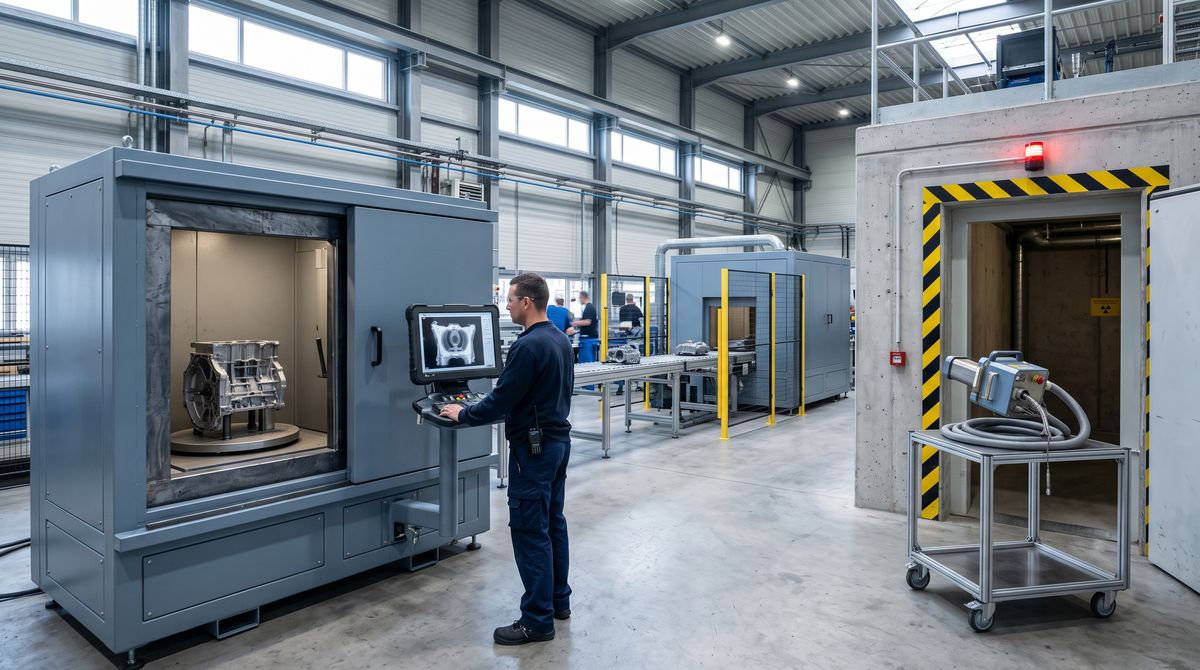
A request often reads, in full, "we need an X-ray machine for our flanges." Three suppliers can answer with three proposals that look nothing alike: a shielded cabinet with a digital panel, a portable generator shooting on film, an automated inline system with a manipulator. None of them is wrong in itself. They answer three different questions, because the request didn't say how many flanges a day, what diameter, which steel, or whether inspection happens in the shop or at final assembly on site.
Industrial X-ray machines divide first by architecture, and the architecture depends on where the shielding sits. Cabinets wrap lead around the part. A bunker makes the room itself the shield, and the part comes in on the overhead crane. A portable generator has no shielding at all, so protection comes from distance, time and a cordoned-off area for every exposure. An inline system is a cabinet built around a conveyor or a robot, and computed tomography adds a rotary table and a reconstruction engine. Everything else, from the X-ray tube to the detector, is chosen afterward, inside the right architecture.
Five architectures compared, before talking kV
The table lines up the differences that drive the choice. They're general indications, to be checked against the actual part and installation site.
| Architecture | Where it works best | Typical limit | What drives total cost |
|---|---|---|---|
| Shielded cabinet | Small and medium parts, repeat batches, production floor | Usable volume and maximum tube voltage | Floor load, detector, part handling |
| Bunker | Large or heavy parts, thick sections, NDT lab | Civil works and permanently occupied space | Shielding, interlocked doors, overhead crane |
| Portable generator | Field welds, pipelines, tanks, plant shutdowns | Area to clear for every exposure | Idle crews, night shifts, personnel |
| Inline radioscopy or DR | High volumes of castings, wheels, welded series parts | Stable part family, cycle time | Automation, software, feasibility trial |
| Computed tomography (CT) | Defects to locate in 3D, internal measurements, first articles | Scan time and part size | Dedicated system or outsourced service |
This alone shows why list price says little. A cabinet and a bunker with the same tube can produce identical images, but the cabinet goes into a production area in a few weeks while the bunker needs a construction project. The portable unit costs less than either to buy and shifts the rest of the bill onto site logistics.
The shielded cabinet, when the part fits through the door
A self-shielded cabinet encloses source, part and detector in a steel and lead housing, with interlocked doors that cut high voltage when opened. A useful public benchmark for what this kind of machine has to guarantee is the US federal rule 21 CFR 1020.40 on cabinet x-ray systems. It sets a limit of 0.5 milliroentgen in one hour at 5 cm from any external surface, a few microsieverts per hour, at least two interlocks per door and a key-actuated control without which X-rays can't be generated. That rule doesn't apply in Italy, but it describes the level expected from a well-designed cabinet.
The economic advantage of a cabinet is where you can put it. Next to the production line, the part doesn't travel to an outside lab or to a bunker at the far end of the plant, and inspection becomes a station in the process. The downside is physical. Every millimeter of lead weighs about 11 kg per square meter of wall, so a cabinet with 16 m² of walls and 8 mm of lead carries almost 1.5 metric tons of lead alone, before frame, tube and manipulator. The floor has to be checked for concentrated loads under the feet.
The second limit is usable volume. Cabinet size is set by the largest part it will ever inspect, fixture included, and buyers who size it on today's parts often find that the casting from the next program won't fit through the door. Write the maximum dimensions expected over the next few years into the request, not those of the current batch. Inside the cabinet the detector can be film, CR plates or a DR panel, and that choice follows volumes, as discussed in the comparison of CR and DR radiography.
Bunker: the room becomes the shield
When the part weighs several tons or exceeds two meters, shielding moves into the walls. A bunker is a concrete room, sometimes with lead or steel inserts, with interlocked doors, warning lights and emergency stops. Wall thickness isn't picked from a catalog. The radiation protection expert calculates it from maximum energy, weekly workload, beam direction and who occupies the adjacent rooms. IAEA guide SSG-11 on radiation safety in industrial radiography separates work in shielded facilities with effective engineering controls from site work with mobile sources, where safety rests mainly on procedures.
The bunker is the most flexible architecture. It can house a fixed high-voltage tube, a portable generator used under controlled conditions, or a gamma source for the heaviest sections, and it takes pressure vessels, large castings and welded fabrications. It also ties up the most capital and floor space, and it's hard to move if the plant layout changes. For an NDT lab or a job shop with varied orders, it's often the sensible choice. For a manufacturer inspecting the same medium-sized component every day, a well-sized cabinet usually costs less overall.
A portable unit goes to the part, and takes the controlled area with it
A portable generator makes sense when the part can't be moved: girth welds on a laid pipeline, tanks, erected structures, plants in shutdown. Directional versus panoramic beam depends on joint geometry and is covered in the guide on how to choose an X-ray tube and generator. What matters here is that without shielding walls, protection comes from distance. Intensity falls with the square of distance, so doubling the radius of the cordoned area cuts the dose rate to a quarter. The value to meet at the boundary, and its check during the first exposure, are set by the radiation protection expert.
The real cost of a portable unit lies in that area. On a site with other contractors at work, a zone a few tens of meters across means stopping the fitters or moving radiography to night shifts, with crews paid by the shift and every reshoot costing another night. For the thickest steel on site, gamma sources come into play. ISO 17636-1:2022 gives iridium-192 a steel thickness range of 20 to 100 mm for technique class A, and selenium-75 a range of 10 to 40 mm. A gamma source, however, brings a licensing regime, a shielded container and transport logistics that an X-ray tube doesn't have.
Not sure which architecture fits your parts?
Send us a drawing or photo of the part, the material, thicknesses and how many inspections you run per month: we help you choose between cabinet, bunker, portable, inline or CT, with a quote within 24 hours.
Email us Message us on WhatsAppInline, cycle time matters more than kV
Above a few hundred parts a day, the question changes. An aluminum foundry, a wheel maker or a producer of welded series parts doesn't need a machine that takes one good radiograph. It needs a station that takes thousands at the same quality. This is where radioscopy and inline DR work, with the part loaded by conveyor or robot, a manipulator orienting it and the image read in real time. The ground rules are in ASTM E1255-23 on radioscopy and, for castings, in EN 12681-2:2017 on techniques with digital detectors. Automated defect recognition has a large body of research behind it, collected in Domingo Mery's Springer book on computer vision for X-ray testing.
The math runs on cycle time. At 30 seconds per part, loading and unloading included, a station inspects 120 parts an hour, just under 2,000 parts over two eight-hour shifts. Most of the economic value comes from where inspection sits in the flow. On 2,000 castings a day, a 1.5% reject rate found after milling means 30 parts machined for nothing. At 12 machine-tool minutes each, that's 6 machine hours lost every day, hours you get back when porosity shows up before machining. When variants change weekly and batches are small, though, automation loses its edge and a manually loaded cabinet comes out ahead again. When radioscopy beats radiography is covered in detail in industrial radioscopy, when it pays.
Tomography, when you need to know how deep the defect is
A radiograph flattens the volume onto a plane. CT reconstructs the part in three dimensions from hundreds or thousands of projections acquired while it rotates, and ISO 15708-2:2025 describes its principles, equipment and sample requirements. It earns its place when it matters where a pore sits relative to a machined surface, when internal wall thicknesses must be measured, or when a first article has to be validated before production starts. The price of that information is time, since a scan takes from a few minutes to several hours and can't keep up with a line.
For many companies, CT demand comes in peaks tied to product development, customer claims or qualifications. In those cases an outsourced industrial CT scanning service costs less than a dedicated system sitting idle most of the year. Once scans become weekly, it's worth evaluating an in-house system, starting from the page on industrial computed tomography.
From part to machine: material, thickness, size and volume
Material shifts the numbers more than most people expect. The NIST attenuation tables for iron and for aluminum show that at 100 keV one centimeter of steel attenuates as much as a little over six centimeters of light alloy, and at 150 keV as much as four. By the same calculation, a narrow 100 keV beam keeps about 5% of its photons through 10 mm of steel and less than 0.3% through 20 mm. A real tube spectrum is broader and practical values differ, but the order of magnitude explains why an aluminum-casting cabinet doesn't become a machine for thick steel welds just by changing the program.
Thickness and geometry then set voltage and technique. General rules for metallic materials are in ISO 5579:2013, and weld rules in ISO 17636-1 for film and ISO 17636-2:2022 for digital detectors. Image quality is demonstrated with the wire indicators of ISO 19232-1:2013, while shops working to US specifications find minimum requirements in ASTM E1742/E1742M-23 and, for panels, in ASTM E2698-26. Each architecture has to reach the required quality class with margin, or the purchase savings get paid back in reshoots. Voltage, focal spot and unsharpness are covered separately in the article on the X-ray tube and focal spot.
Three examples pin the reasoning down. A foundry making aluminum housings with 4 to 10 mm walls, thousands a day, heads toward inline radioscopy. A pressure vessel fabricator with 25 mm joints and twenty-odd welds a week does well in a bunker with a fixed tube, or with a portable unit if vessels leave the shop already assembled. An aerospace supplier with small batches of complex parts finds the right balance of image quality and footprint in a cabinet with a DR panel, and sends first articles to CT. More real cases, with the questions customers actually asked, are collected in the XRF, X-ray and video inspection case studies.
The cost that never shows up on the quote
Two quotes for X-ray machines compare poorly if you only look at the total. Total cost includes civil works, floor space, floor load checks, power and cooling, the radiation protection expert and periodic checks, operator training and, for portable units, site hours lost during exposures. On the other side of the ledger is value. In-house inspection removes shipping to an outside lab and days of waiting for the report, and inspection earlier in the flow avoids machining parts that are already defective. For the calculation per annual exposure, with film, CR and DR compared, the guide on industrial X-ray system cost and purchase works through a typical case.
These costs weigh differently across architectures. The cabinet concentrates spending up front and nearly eliminates organizational costs. A bunker shifts spending to construction and pays it back with versatility. A portable unit is cheap to buy and expensive to use when exposures are frequent in crowded areas, while an inline system only pays off with high volumes and a stable part family.
Radiation protection: change the architecture, change the expert's job
In Italy the framework is Legislative Decree 101 of July 31, 2020, which applies to every architecture. The employer appoints a radiation protection expert under Article 128, and the 200 keV threshold in Article 50 separates practices that need prior authorization from those that need notification. Articles, lead times and the special case of mobile sources are covered in the buying guide linked above. This is general information, not a substitute for the expert's assessment of your case.
What changes from one architecture to the next is the nature of the work. With a cabinet, the expert mainly assesses the integrity of the housing and interlocks, and the area around the machine often stays an ordinary production floor. With a bunker, the expert reviews the wall and door design in advance. With a portable unit, safety is rebuilt on every job, with a cordoned area, boundary measurements and written procedures, and it depends much more on people. For this reason, at equal image quality, many companies move everything that can be moved into a cabinet or bunker and keep portable units for parts that stay put.
Before the quote, a trial on your part
The criterion that holds all the others together is to start from the hardest part, the thickest, the largest or the one with the worst geometry, and from the number of inspections you'll run three years from now. If that part passes with margin, the rest of production will too. A trial on real samples, with known or suspected defects, tells you more than any datasheet, and on that basis you choose among the X-ray generators and radiography systems we distribute or a custom solution. The full picture of techniques is on the industrial radiography page.
What to send us for an assessment
To point you to the right architecture for your parts, we just need a few details:
- a drawing or photo of the part, with maximum size and weight, including future programs;
- material and maximum thickness crossed by the beam;
- defects to detect and the code or specification to meet;
- how many parts you inspect per day or month, and whether inspection is 100% or by sampling;
- where inspection will take place, on the production floor, in a lab or in the field;
- whether you already have a bunker, a cabinet or an appointed radiation protection expert.
You can send them by email to info@dipitech.com or on WhatsApp. You can also use the contact form.
With these details we help you choose the industrial X-ray machine and the detector, with a quote within 24 hours and, when needed, a trial on your own material.
Request a quote
Leave your name, email, and a few lines about your application, with no obligation. We reply within 24 hours with initial technical guidance and a quote.
Frequently asked questions about industrial X-ray machines
What is the difference between an X-ray cabinet and a bunker?
In a cabinet, steel and lead shielding encloses part, source and detector, and the machine can be installed on a production floor. In a bunker, the concrete room is the shield, with interlocked doors and walls calculated by the radiation protection expert. A cabinet suits small and medium series parts, a bunker large or heavy parts and varied work.
When does a portable X-ray generator make sense?
When the part can't be moved, such as welds on laid pipelines, tanks or plants in shutdown. Without shielding walls, protection comes from distance and a cordoned-off area for every exposure, which adds to site costs. If the part can be brought into a cabinet or bunker, that's usually the better option.
Which X-ray machine is right for inspecting aluminum castings in production?
With hundreds or thousands of castings a day, the usual answer is inline radioscopy or DR, with automatic loading and a cycle time of a few tens of seconds. With small batches and frequent variants, a cabinet with a DR panel and manual loading is often more cost-effective. The choice is confirmed with a trial on real parts.
Does an industrial X-ray machine need authorization?
In Italy, Legislative Decree 101/2020 applies to every type of machine. The employer appoints a radiation protection expert and, depending on energy, the practice is notified or requires prior authorization, with a 200 keV threshold. This is general information: the path for your case is defined by the radiation protection expert.
Is it better to buy a CT system or use a CT scanning service?
If scans are needed in peaks, for product development, customer claims or first articles, an outsourced CT scanning service costs less than a machine sitting idle most of the year. Once scans become weekly, an in-house system is worth evaluating.
What details are needed for an industrial X-ray machine quote?
A drawing or photo of the part with maximum size and weight, material and maximum thickness, defects to detect and the applicable code, number of inspections per day or month, where inspection takes place and any existing installations. With these details DIPITECH helps you choose and prepares a quote within 24 hours.