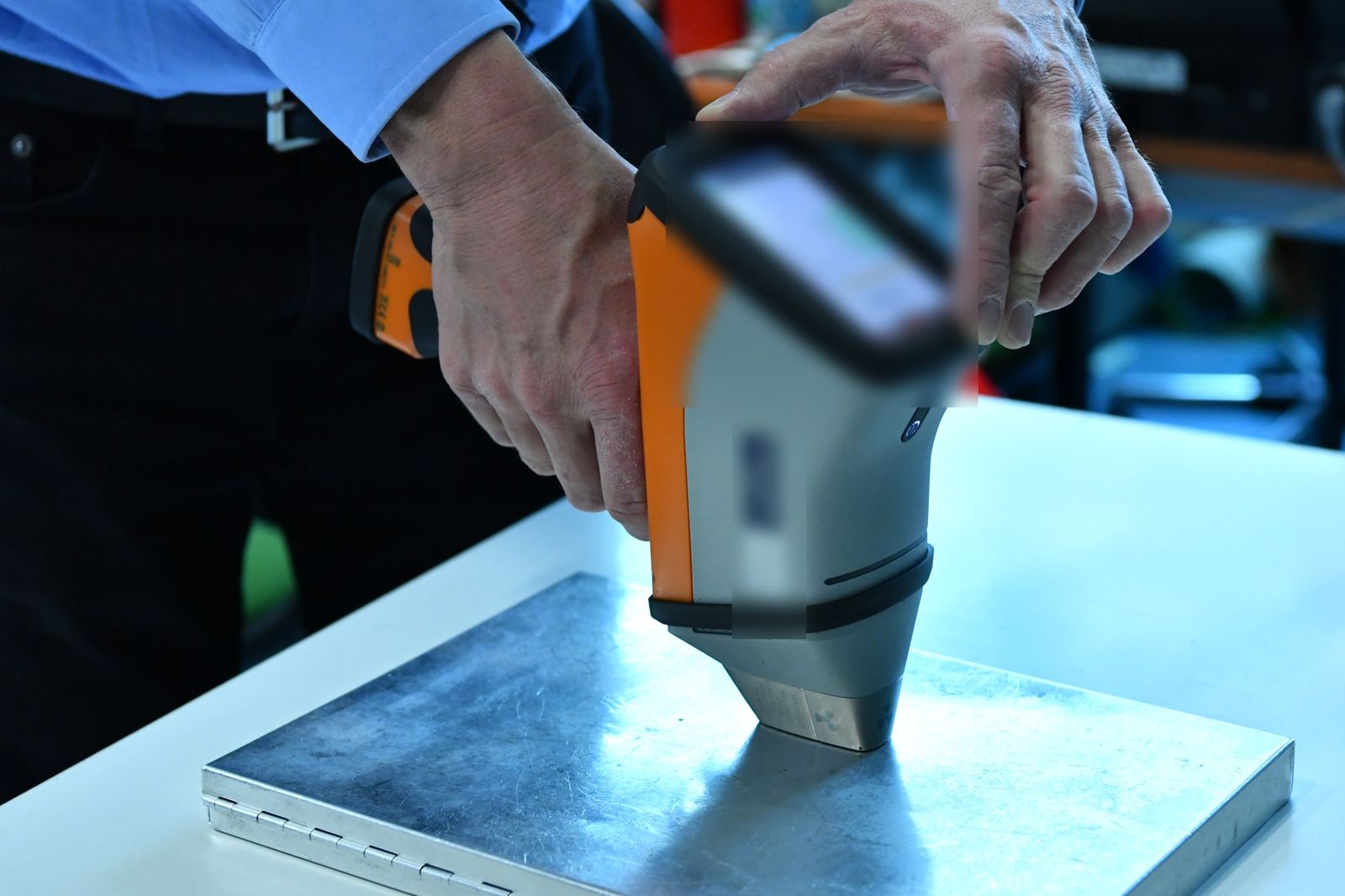
The questions on this page are the ones people type most often into search engines when they run into XRF, whether in a lab, at a gold buyer's counter or in incoming material inspection.
Choosing an instrument is covered on the page about the handheld XRF analyzer and portable spectrometer. If your question is not here, send it through the form at the bottom of the page and we will reply within 24 hours.
What XRF is and how it works
What does XRF stand for?
XRF stands for X-ray fluorescence, an elemental analysis technique that hits the material with X-rays and reads the secondary X-rays each element re-emits at its own energies. Those energies tell you which elements are present, and their intensity tells you how much of each, without damaging the part. Industrial applications are described on the page about XRF material analysis.
Is XRF spectroscopy or spectrometry?
Both terms are used, and both are correct. Spectroscopy is the study of how matter emits or absorbs radiation, spectrometry is the quantitative measurement, so an XRF instrument is properly a spectrometer. Spectrophotometry, a term sometimes used as well, belongs to instruments that measure absorbed visible or ultraviolet light, while XRF counts emitted X-ray photons and measures their energy. A lab spectrometer and a handheld XRF analyzer make the same kind of measurement.
How does XRF work?
X-rays from a tube strike the sample and knock electrons out of the atoms' inner shells. When outer electrons fill those vacancies, the atom emits X-rays at energies characteristic of the element, its lines. The detector counts these photons and measures their energy, then the software turns the spectrum into a composition and, for metals, into an alloy grade. Detectors and calibrations are explained in the guide on how to choose a portable XRF analyzer.
What excitation sources are used in XRF spectroscopy?
Today it is almost always an X-ray tube, which emits only when switched on and can be adjusted in voltage and current. Laboratory spectrometers often use a rhodium anode, while handheld units use a miniature tube. EPA Method 6200 for field XRF also allows radioactive sources such as cadmium-109, which require different storage and licensing. Handheld configurations are described in our XRF and PMI analysis solutions.
How is energy expressed in an XRF spectrum?
In kiloelectronvolts (keV), on the horizontal axis of the spectrum, while the vertical axis shows counts, meaning how many photons the detector recorded at each energy. Each element appears as peaks at fixed energies, for example the iron Kα line at about 6.40 keV and the gold Lα line at 9.71 keV. The peak area, corrected for matrix effects, leads to the concentration.
What is the difference between XRF and XRD?
XRF tells you which elements are present and in what amounts, XRD tells you which crystalline phases contain them. Diffraction measures the angles at which a crystal lattice deflects X-rays according to Bragg's law, and so identifies minerals and compounds such as quartz or calcite. Metal inspection and PMI need composition, so they use XRF analysis, while XRD remains a laboratory tool for mineralogy and materials science.
What XRF can and cannot measure
What is XRF used for?
XRF reveals the elemental composition of a material without destroying it. In industry it identifies alloys at receiving inspection and in PMI, sorts scrap, verifies the fineness of gold and silver, measures the thickness of metal coatings and screens soils and ores. In the lab it analyzes cement, glass, catalysts and cultural heritage objects. Industrial applications are described on the page about XRF and PMI material analysis.
What elements can XRF detect?
EPA Method 6200 treats elements from atomic number 16, sulfur, upward as detectable by field XRF. With an SDD detector and longer measurement times, current analyzers also read magnesium, aluminum, silicon and phosphorus, with higher detection limits. Lithium, beryllium, boron and carbon remain out of reach for handheld analyzers. Details by matrix and measurement mode are in the article on portable XRF for ores and minerals.
Why can't XRF detect carbon?
Because the carbon signal is lost before it reaches the detector. Its line sits at about 0.28 keV, the atom emits very little fluorescence, and those photons are absorbed by the part itself, by air and by the detector window. As a result handheld XRF cannot separate 304 from 304L, and carbon or L grades call for argon-purged LIBS or spark spectrometry. The comparison is in the article on LIBS and XRF for carbon.
How accurate is XRF analysis?
On clean, homogeneous metal, precision is high for the major elements and drops for light elements and traces. Three things drive it: counting statistics, a calibration built on materials similar to yours and a representative surface. On the statistics side, halving the uncertainty takes four times the measurement time. The practical check is a daily reading of a certified reference material, as the guide on choosing an XRF analyzer explains.
What is the difference between XRF and OES?
OES, optical emission spectrometry with a spark, vaporizes a spot on a prepared sample and reads the light emitted, so it also measures carbon, phosphorus and sulfur using methods such as ASTM E415. An XRF spectrometer uses X-rays instead, leaves no mark and works on the finished part, but it cannot see carbon. Many companies use both, as the article on XRF in the foundry shows.
Gold and precious metals
What is XRF analysis for precious metals?
This is the non-destructive measurement of the fineness of gold, silver, platinum and palladium with an XRF spectrometer, in a few seconds and without acids. The instrument reports fineness in parts per thousand, for example 750 for 18-karat gold, along with the alloy composition. ISO 23345:2021 covers the use of XRF to confirm the declared fineness of homogeneous, uncoated jewelry. Method and limits are in the guide on XRF analysis of gold and precious metals.
What is the best XRF for gold?
Gold analyzers come in two families. Benchtop spectrometers with a shielded chamber, collimator and camera measure small spots on jewelry and small bars and archive the spectra, while handheld units fit large parts or inspections on the move. Within either format, detector resolution, which separates gold from platinum, and calibrations on your alloys make the difference. The counter procedure is in the article on verifying gold fineness with XRF.
Can XRF detect fake or plated gold?
Only partly, since it reads just a few micrometers of surface. In pure gold the Lα line is attenuated to 1/e in about 4 micrometers, according to NIST coefficients, so plating a few micrometers thick hides the base metal. Thin plating shows up when you measure several spots and read the spectrum, thick plating after a small file cut in a hidden area. Valuable bars need a through-thickness test, as explained in the counter verification procedure.
Can XRF replace fire assay?
Not for the fineness that carries legal weight. In Italy the reference method for gold remains cupellation under UNI EN ISO 11426, referenced by the ministerial decree of March 19, 2025, which melts and destroys the sample. XRF is the tool for fast checks and screening, and it flags which pieces should go to assay when readings disagree with the declared fineness. The full comparison is in the guide on XRF analysis of precious metals.
Need to choose an XRF analyzer?
Tell us what you measure (alloys, gold or scrap), how many parts a day and what answer you need. We help you choose a handheld or benchtop XRF spectrometer and, if needed, arrange a test on your material. Reply within 24 hours.
Email us Message us on WhatsAppAlloys, scrap and PMI
What are the differences between XRF and PMI?
XRF is the measuring technique, while PMI (positive material identification) is the check that confirms a component is made of the specified alloy. PMI is often done with a handheld XRF analyzer, or with LIBS and spark spectrometry when carbon matters. The program and methods are described in API RP 578 and in the ASTM E1476 guide. Piping and weld applications are covered in the article on PMI in oil and gas.
Can XRF tell 316 from 316L stainless steel?
No, because the two grades differ only in maximum carbon content, which handheld X-ray fluorescence does not measure, while their chromium, nickel and molybdenum ranges are the same. Separating them takes LIBS configured for carbon or spark spectrometry. Alternatively you rely on the EN 10204 3.1 certificate and use XRF to confirm that the rest of the composition is consistent. The topic is covered in the article on material traceability and PMI.
What is a portable metal spectrometer used for?
A portable metal spectrometer, XRF or LIBS, identifies the alloy of a part on the spot, in a few seconds and without cutting samples. Typical uses are receiving inspection, warehouses to catch mixed-up alloys, scrap yards separating stainless steel, copper, brass and nickel alloys, and plant PMI of piping and welds. In scrap, correct sorting changes the value of a lot, as the article on alloy sorting in the scrap yard shows.
Choosing an analyzer and understanding costs
Which XRF analyzer is best?
The best one is configured for your materials and for the question you need to answer, because no ranking fits everyone. Aluminum alloys, light elements and high volumes call for an SDD detector, a few very different alloys may be fine with a Si-PIN, and gold and precious metals depend on collimation and dedicated calibrations. What decides is repeatability measured on your own parts. The steps are in the guide on how to choose a portable XRF analyzer.
How much does a handheld XRF analyzer cost?
The price depends mainly on the detector and the calibrations included, then on accessories, software, calibration service and support. An instrument with an SDD and alloy, precious metal and soil modes costs more than one with only the industrial library. Follow-on costs count too, from reference materials to radiation protection. DIPITECH prepares a tailored quote within 24 hours. The cost items are explained in the article on handheld XRF analyzer cost.
How much does XRF testing cost?
The cost of a lab analysis varies with matrix, number of elements, sample preparation and report type, so ask with the sample in hand. For results that must hold up with third parties, use a laboratory accredited to ISO/IEC 17025, which in Italy you can find in the Accredia database. When analyses are frequent, shipping and waiting time weigh more than the unit price, and it pays to compare the lab with an in-house instrument, as the article on XRF analyzer cost does.
Can you rent an XRF analyzer?
Yes. Besides buying, you can work out with DIPITECH a rental of a handheld XRF analyzer, for example for 12 months, with a monthly fee and terms set out in the quote. Renting suits needs that are limited in time, or companies that prefer a fee to an upfront investment, while with continuous use buying usually costs less. Compare the options on cost per verified part, counting days of use per year, and keep in mind that radiation protection requirements apply to a rented unit too. Available configurations are on the page about the handheld XRF analyzer.
Safety, regulations and calibration
Are handheld XRF analyzers safe?
They are designed to keep operator exposure low, as long as you use them as the manufacturer and your radiation protection expert prescribe. The beam is narrow, emitted only during a measurement and largely absorbed by the part. Risks come from misuse, such as pointing the analyzer at people, measuring with nothing in front of it or holding small samples against the window by hand. Small parts go in a shielded stand.
What are XRF calibration standards?
They are certified reference materials (CRMs) with known composition and stated uncertainty, such as NIST SRMs or materials from producers working to ISO 17034. The analyzer ships factory-calibrated, then at the start of each shift you measure a CRM of the alloy family being inspected and record the deviation, while at longer intervals the instrument goes back for verification or recalibration. Your quality system sets the interval, as the guide on how to choose a portable XRF analyzer explains.
What to send us for an assessment
To point you to the right instrument we only need a few details:
- materials or alloys to analyze, with the most common families;
- the elements that really matter, including light ones;
- your goal, whether alloy identification, quantification or precious metal fineness;
- parts or readings per day and where you measure, at a bench, in a yard or in a plant;
- the standard, specification or customer that requires the check;
- your current instrument or outside lab, with the waiting times.
You can send them by email at info@dipitech.com or on WhatsApp, attaching a photo of a typical part and a reference certificate if you have them. You can also use the contact form.
With these details we help you choose the handheld XRF analyzer or benchtop spectrometer that fits your materials. Available configurations are on the page about the handheld XRF analyzer and portable spectrometer.
Request a quote
Leave your name, email, and a few lines about your application, with no obligation. We reply within 24 hours with initial technical guidance and a quote.