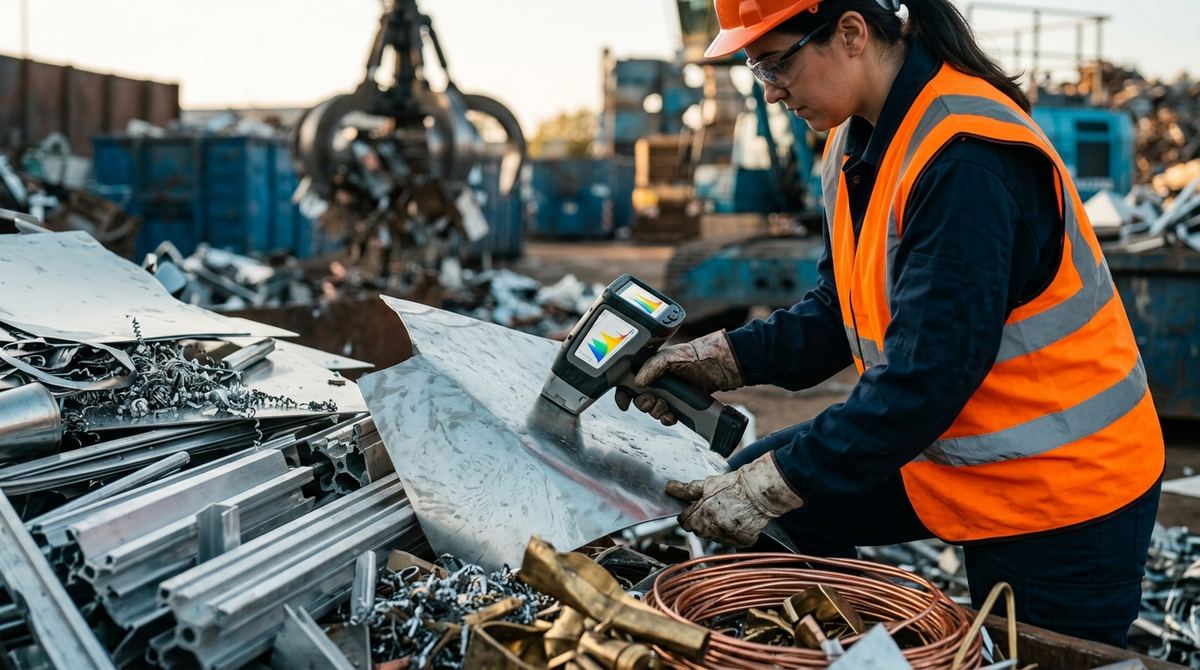
Ask for a quote on a handheld metal analyzer for a scrap yard and you will almost always get a datasheet back: seconds per measurement, number of grades in the library, ingress rating. The figures are real, but they start at the wrong end. The right instrument depends on what comes through the gate every week. A yard that lives on stainless, nickel alloys and copper needs a well-configured handheld XRF; one that handles mostly demolition aluminum, or has to grade steels by carbon content, can easily buy the wrong technique. Here the focus is the choice of instrument. The sorting procedure itself, from magnet triage to the lot file, is covered in our article on scrap yard alloy sorting and recovery value. The criteria that apply in every industry are in the guide on how to choose a portable XRF analyzer.
Three field techniques, three different answers on the same alloys
Three families of metal spectrometers share the field market. Handheld XRF irradiates the piece with a small X-ray tube and reads the fluorescence of the elements. It is fast, leaves no mark and sees elements from titanium upward well. In air it loses sensitivity on magnesium, aluminum and silicon and can't see the lighter elements at all, carbon included. Handheld LIBS vaporizes a microscopic spot with a laser pulse and analyzes the light from the plasma. It reads light elements too and, in models with argon purge, carbon, but it leaves a small mark and needs a clean surface. Mobile optical emission spectrometry (OES) uses a spark in an argon atmosphere. Of the field techniques it is the closest to the lab for carbon, phosphorus and sulfur in steels, and it pays for that with a cart, a gas cylinder and careful spot preparation.
The standards help sort this out. ASTM E1476-04, reapproved in 2022, describes X-ray fluorescence and optical emission among the methods for metals identification, grade verification and sorting. ASTM E1916-24, on mixed lots, adds that the same methods may be used to identify and segregate scrap, and warns that sorting done on the plant floor doesn't have laboratory accuracy and doesn't establish conformance to a specification. What a yard buys, then, is the ability to decide quickly which grade a piece belongs to, while full conformance, when it is needed, remains lab work.
| Alloy family | Handheld XRF | Handheld LIBS | Mobile spark OES |
|---|---|---|---|
| 300 and 400 series stainless, 304 and 316 | Fast separation on Cr, Ni and Mo, no mark | Good separation, spot must be cleaned | Full separation, L grades included |
| Nickel, titanium and copper alloys | Strong point: heavy elements measured well | Possible, libraries to check against your mix | Possible, impractical between bins |
| Aluminum 5xxx, 6xxx and castings | Magnesium and silicon read slowly and with effort | Light elements read in a few pulses | Possible with an aluminum-matrix program |
| Carbon steels and cast irons by C content | Carbon not measurable | Only models with argon rated for carbon | Reference field technique |
If your yard mostly sees stainless, nickel alloys, copper and titanium, handheld XRF covers the separations that set the price and doesn't mark the pieces you resell. When aluminum carries real weight in your volumes, put LIBS to the test as well, on the same series you handle. If your customers pay for steels by carbon content, neither is enough on its own, and mobile OES or the lab enters the picture. The physics of the problem is explained in our comparison of LIBS and XRF on carbon.
Aluminum and light alloys, where the techniques part ways
Aluminum is the material where the instrument choice changes most. In Europe, aluminum scrap categories are defined by the EN 13920 series. EN 13920-1:2003 sets general requirements, sampling and tests. Later parts separate, for example, scrap of one single wrought alloy (Part 4), of two or more wrought alloys of the same series (Part 5), castings (Part 7) and turnings (Part 12). On the international market, the ReMA ISRI nonferrous specifications, long known as the Scrap Specifications Circular, keep aluminum in a section of its own, apart from nickel, stainless and high-temperature alloys. Selling a fraction under the right category means recognizing the series, and that is where magnesium and silicon come in.
In the 5xxx and 6xxx series and in casting alloys, those two elements make the difference. XRF in air struggles with them because their fluorescence is weak and the air absorbs it before it reaches the detector. Instruments with a silicon drift detector (SDD) can read them with longer counting times, an acceptable trade-off if aluminum is a minor part of the business. Here LIBS starts with an advantage. The Fraunhofer ILT group (Werheit, Fricke-Begemann, Gesing and Noll, Journal of Analytical Atomic Spectrometry, 2011) identified wrought and cast alloys piece by piece on an automated laser-scanning line. On wrought alloys from production scrap, mean identification correctness was above 95%. The same group's 2018 review (Noll and co-authors, JAAS) names positive material identification of metals and the sorting of light-metal scrap as the technique's two main industrial fields. These results come from inline systems: the physics carries over to handheld instruments, while speed and precision have to be checked model by model.
The stakes are high for a reason that the review by Gaustad, Olivetti and Kirchain in Resources, Conservation and Recycling (2012) makes plain. Silicon, magnesium, iron, copper and zinc build up in recycled aluminum streams and limit their reuse, so a wrong series in the bin costs money downstream. For yards handling aluminum in serious volumes, handheld PMI LIBS analyzers deserve a test alongside XRF before any decision.
Want to know which technique holds up on your scrap?
Tell us your alloy families and weekly volumes, with a few photos of a typical bin. We'll tell you whether XRF is enough or whether you need LIBS or both, arrange a test on your own material at no obligation and prepare a tailored quote within 24 hours.
Email us Message us on WhatsAppDetector, tube and libraries: what to read on the datasheet
Once the technique is chosen, the datasheet should be read with the yard in mind. On the detector, the difference that matters is between SDD and older Si-PIN detectors. An SDD handles higher count rates and resolves neighboring peaks better, reaches a stable result sooner and is what makes magnesium and silicon measurable in practice. The tube matters for the elements you care about, because tube voltage and anode material decide which lines are excited well. A serious manufacturer states the measuring conditions for each analytical program.
The most underrated item is the grade library. The instrument doesn't recognize an alloy: it compares the measured composition with a list of tabulated alloys and reports the closest match above a similarity threshold. That list speaks in designations such as AISI 316, UNS N06625 or EN AW-6082, while you sell by commercial grades in the ReMA specifications or by EN 13920 categories. Someone decides how designations map onto grades, once, when the instrument is configured. That mapping should be written down, the library should accept custom grades and thresholds, and whoever sets it up should know the price gap behind each threshold. Leaving everything at factory settings means letting the software decide where one grade ends and the next begins.
Dust, rain and a full shift in your hand
In a yard the instrument gets dropped, gets wet and works among metal dust. Protection is stated by the IP code of IEC 60529: the first digit covers dust, the second water, and IP54 and IP65 describe two very different lives in an open-air area. Then there is the protection of the measuring window, the most delicate part, which gets damaged on sharp edges and turnings. Equally important is the temperature range in which the instrument keeps measuring in summer, on top of a bin in full sun.
On speed, what counts is time per piece, far more than minimum acquisition time. Time per piece includes picking the piece up, cleaning the spot, the reading itself and the repeat when the result lands close to a threshold, and on a mixed bin it weighs more than the seconds of measurement. In the example worked through in the sorting article, three hundred austenitic pieces take one operator about two hours. Those are the hours where a light, well-balanced instrument with a display readable in full sun and a trigger that is comfortable with gloves really saves time. Hot-swappable batteries and enough capacity for a full shift complete the picture, because power outlets are a long way from the bins.
From spectrum to shipping document
The commercial value of a reading shows on the day a load is disputed. A yard instrument should store every reading with its spectrum, date, serial number and lot reference, ideally with a photo of the piece, and export the data in a format that reaches the shipping documents without retyping. Regulation (EU) No 333/2011 for iron, steel and aluminum and Regulation (EU) No 715/2013 for copper require anyone selling scrap as end-of-waste material to run a quality management system and issue a statement of conformity for each consignment. Neither prescribes an instrument, and the analyzer's data are the simplest evidence to attach. If you sell to foundries, our article on alloy verification in the foundry shows how the buyer checks incoming material.
Reading a reference sample at the start of the shift is the other half of the evidence. A certified material such as NIST SRM 1155a, an AISI 316 type stainless steel with certified composition, shows that on that day the instrument read molybdenum where it should. Many users do the same with certified samples of the alloys they handle most. The full content of a lot file, including the sampling rule to agree with the buyer, is in the sorting article mentioned above.
Radiation protection, rental and testing before you buy
A handheld XRF contains an X-ray tube, and in Italy its use is a practice regulated by Legislative Decree 101/2020. As a rule that means prior notification and an assessment by a radiation protection expert, best started together with the order. LIBS works with a high-power laser instead of X-rays, and that laser comes with its own rules of use and protective measures.
Before buying, the most useful check is still a test on your own material: a typical bin measured with the candidate technique says more than any datasheet. DIPITECH arranges the test at no obligation and, when you need to see the instrument at work between the bins, an on-site demonstration. To cover a seasonal peak or evaluate a technique for a few weeks, ask whether rental is available for the configuration you need. After delivery, what counts is technical support in Italy and a replacement instrument during repairs, because a yard without an analyzer goes back to sorting by eye.
What drives the cost of a scrap yard instrument
Cost follows the choices made so far, which is why no single price list exists. The technique comes first, because XRF, LIBS with argon purge and mobile OES have different architectures and consumables. Then come the detector and the calibration programs for the matrices you handle, aluminum and light elements above all. After those come the ingress rating, accessories such as sample cups for turnings, the lot-management software, and the service package covering calibration checks and a replacement instrument. Start-up costs add to these: the radiation protection paperwork for an XRF, argon cylinders for LIBS and OES. The method for comparing purchase, rental and an outside lab on your volumes is in our article on the cost of a handheld XRF analyzer. The available configurations are collected on the pages for handheld XRF spectrometers and XRF/PMI material analysis and for XRF analyzers for PMI and alloy sorting.
What to send us for an assessment
To tell you which spectrometer your yard needs, a few realistic data points are enough:
- alloy families handled and the rough share of each in your volumes: stainless, nickel, copper, aluminum, titanium, ferrous;
- weekly or monthly volumes and the average number of pieces to measure per shift;
- material form: whole parts, sheet, tube, wire, turnings, shredded;
- your buyers' grades or specifications (ReMA ISRI, EN 13920, steel mill or foundry specification) and whether they also pay for carbon;
- working conditions: covered or open area, dust, temperatures, who will use the instrument;
- how you document lots today and any recent disputes;
- a few sample pieces available for the test.
You can send them by email to info@dipitech.com or on WhatsApp, attaching photos of the material.
The underlying test is simple. If the value in your bin sits in heavy, easily recognized alloys, a yard XRF is a quick choice. If it sits in aluminum or in carbon, a test on your own material is the step that prevents the wrong purchase.
Frequently asked questions about handheld spectrometers for scrap
XRF or LIBS: which is better for a scrap yard?
It depends on two things: how much aluminum you handle and whether your customers pay for steels by carbon content. With stainless, nickel alloys, copper and titanium, handheld XRF covers the separations that set the price and leaves no mark. With a lot of 5xxx and 6xxx aluminum, or with carbon-based grading, LIBS with argon purge or mobile OES becomes necessary.
Is a handheld spectrometer enough to certify a scrap lot?
No, it identifies and separates. ASTM E1916-24 points out that sorting done on the plant floor doesn't have laboratory accuracy and doesn't establish conformance to a specification. High-value lots or formal disputes need lab analysis, while the readings stored by the instrument document the sorting that was done.
What IP rating is needed for outdoor work?
Start from protection against dust and splashing water, meaning at least IP54 under IEC 60529, and check how the measuring window is protected. A high IP code doesn't make up for a window that gets damaged on turnings: ask about replacement time and cost before you buy.
How does the instrument's library connect to scrap sales grades?
Through a mapping table that has to be written when the instrument is configured. The instrument reports designations such as AISI 316 or EN AW-6082, while scrap is sold by ReMA ISRI grades or EN 13920 categories: custom grades and thresholds should be set on exactly the grades that make the price difference.
How much does a handheld spectrometer for scrap cost?
It depends mainly on the technique and the calibration programs. An XRF for stainless and heavy alloys, one with aluminum calibrations and a LIBS with argon all cost differently, and accessories, lot software, service and the radiation protection paperwork add to that. DIPITECH prepares a tailored quote within 24 hours based on your yard's data.
Can I test the instrument before buying it?
Yes, DIPITECH arranges a test on your own material at no obligation and, when needed, an on-site demonstration. It is the quickest way to measure the real time per piece on your scrap, which matters more than the measuring time on the datasheet.